
Younger men do not need older men to perform wisdom at them.
They need to see it lived.
That is a harder assignment.
Any man can give a speech about discipline, responsibility, respect, hard work, humility, or character. Speeches are cheap. Advice is cheap. Complaining about “kids today” is especially cheap, and there is a lot of it in circulation.
The real question is simpler and more uncomfortable:
What does a younger man learn by watching you?
Not what you say you believe.
Not what you post.
Not what you complain about.
Not what you claim to have been back in the day.
What does your behavior teach?
That is where older men either strengthen the next generation or quietly poison it.
Healthy masculinity is not passed down mostly through lectures. It is passed down through example, restraint, correction, humor, humility, responsibility, and the way a man carries himself when he has enough years behind him to know better.
That is part of Healthy Masculinity. A man’s strength should become more useful with age, not just louder.
Younger Men Are Watching More Than They Are Listening
Younger men often listen less than older men wish.
That is annoying.
It is also normal.
Most of us were the same way at some point. We thought we knew more than we did. We dismissed warnings. We had to learn some lessons the expensive way. We confused energy with wisdom and confidence with competence.
That does not mean older men have no influence.
It means the influence often comes through observation before instruction.
A younger man watches how an older man handles frustration.
He watches whether he tells the truth when truth costs him.
He watches whether he treats women with respect when no one important is watching.
He watches whether he admits mistakes or rewrites history.
He watches whether he works hard or only talks about how hard he used to work.
He watches whether he corrects younger people with dignity or humiliation.
He watches whether age has made the man wiser, calmer, and more grounded, or just bitter and loud.
The lesson is always being taught.
The only question is what lesson your life is giving.
Example travels farther than instruction
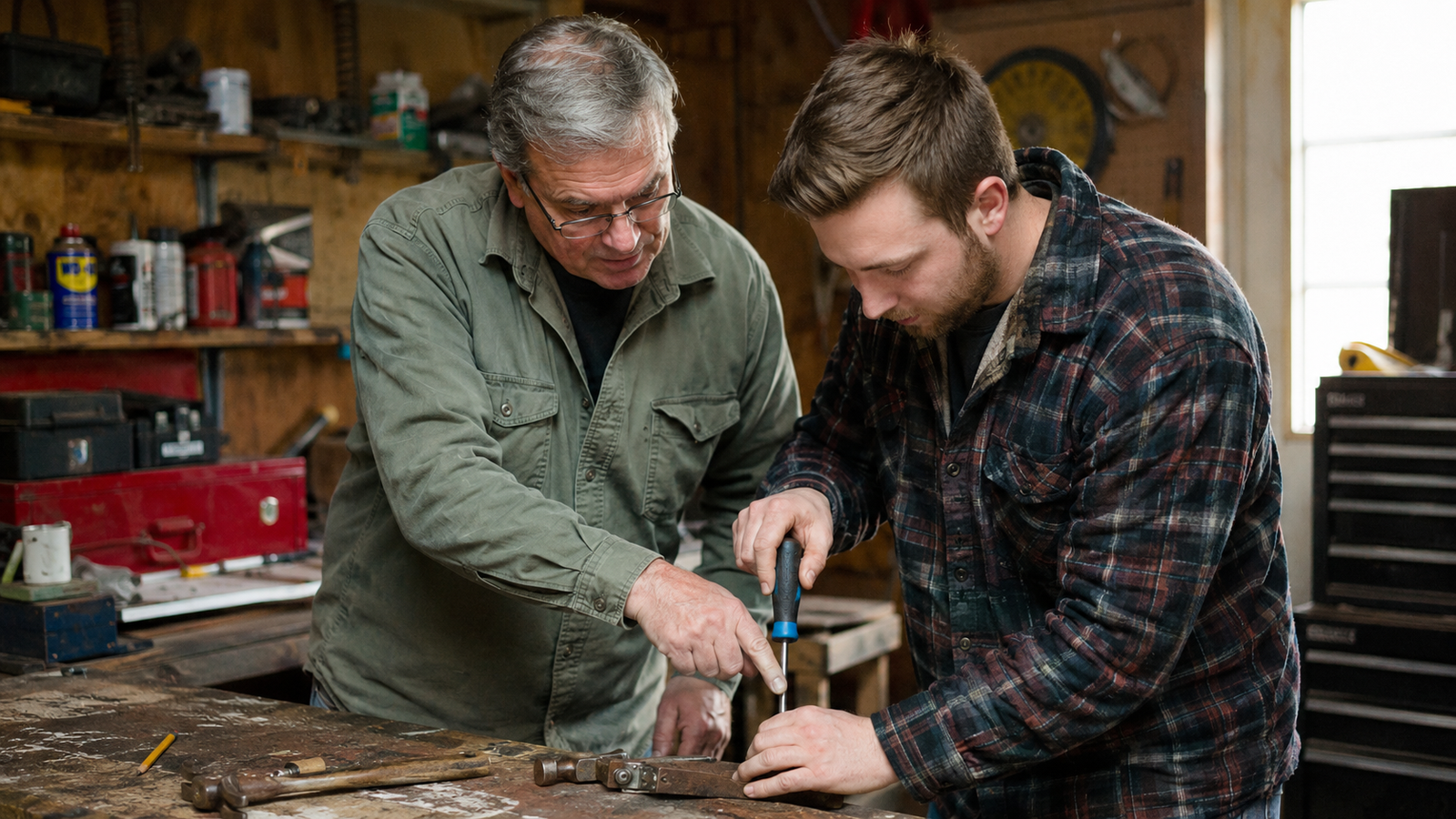
Younger men notice how an older man handles pressure, correction, failure, authority, and repair. The lesson is already being taught before any advice is offered.
Do Not Confuse Age With Wisdom
Getting older gives a man experience.
It does not automatically give him wisdom.
Experience is what happened.
Wisdom is what you learned from it.
Some men live through decades and come out deeper, steadier, more patient, more useful, and more honest.
Other men live through decades and come out with the same emotional habits they had at thirty, only with better stories and worse knees.
Age can sharpen a man.
It can also calcify him.
That is why older men need Lifelong Learning as much as younger men do. Maybe more. A man who stops learning eventually starts confusing memory with truth and opinion with character.
Younger men can smell that.
They may not say it out loud, but they know when an older man is still growing and when he is just defending the past.
A useful older man can say:
“I’ve seen this before.”
He can also say:
“I may be missing something.”
Both statements can be true.
The first gives experience.
The second keeps experience from becoming arrogance.

The Best Teaching Is Often Quiet
A younger man does not always need a formal mentor.
Sometimes he needs to see a man do the ordinary things well.
Show up on time.
Keep your word.
Treat people with basic respect.
Control your temper.
Fix what you broke.
Pay what you owe.
Say thank you.
Apologize without turning it into a courtroom defense.
Take care of your body enough to remain useful.
Stay interested in the world instead of acting like everything good ended when you were young.
Do the boring responsibilities without demanding a parade.
These things do not look dramatic.
That is why they matter.
A lot of healthy masculinity is boring from the outside. It is a man doing what needs done, repeatedly, without turning every act of responsibility into a performance.
Younger men need to see that.
They need to see that manhood is not just conquest, anger, money, muscle, sex, dominance, or status.
They need to see steadiness.
Steadiness is rarely flashy, but it is hard to fake for long.
Correction Works Better Without Humiliation
Older men have a responsibility to correct younger men when correction is needed.
That does not mean being soft. Some behavior deserves a hard stop. Cruelty, laziness, dishonesty, abuse, recklessness, and excuse-making should not be politely ignored in the name of being supportive.
But correction does not require humiliation.
A man can be direct without being cruel.
He can say:
“That was wrong.”
“You need to clean that up.”
“You are making excuses.”
“You are better than this.”
“That is not how you treat people.”
“You are confusing anger with strength.”
Those sentences can land hard enough.
Adding contempt usually does not improve the lesson. It often just teaches the younger man to avoid you, lie better, or harden himself against correction altogether.
There is a difference between giving a man a standard and trying to crush him under it.
A good older man corrects in a way that leaves the younger man with a path forward.
Not a free pass.
Not soft approval.
A path.
That is the difference between discipline and ego.
Stop Performing the “Back in My Day” Routine
Every generation thinks the next one is soft, distracted, entitled, confused, or doomed.
Sometimes there is truth in the complaint.
Often there is also laziness in it.
“Back in my day” can become an excuse to stop understanding the world as it exists now.
The world younger men are facing is not the same one older men entered. Work has changed. Dating has changed. technology has changed. family structures have changed. housing costs have changed. public trust has changed. information overload has changed the way people think and compare themselves.
That does not mean younger men get a pass on responsibility.
It does mean older men should be careful before turning every struggle into a character defect.
A better approach is:
“That is different from what I dealt with. Help me understand it. Then let’s talk about what still comes down to discipline, judgment, and responsibility.”
That posture does two useful things.
It keeps the older man from becoming dismissive.
It also keeps the younger man from escaping accountability.
That is a better conversation than another tired speech about how nobody wants to work anymore.
Show Strength Without Dominance
Younger men need to see that strength does not require domination.
They need older men who can lead without controlling every person in the room.
They need to see a man disagree without becoming vicious.
They need to see a man stay calm when challenged.
They need to see a man protect without possessing.
They need to see a man hold standards without contempt.
They need to see a man who does not confuse fear with respect.
This matters because many younger men are looking for masculine models. If mature men do not provide better examples, loud frauds will happily fill the vacuum.
The internet is full of men selling dominance as identity. Some of it is cartoonish. Some of it is seductive because it gives confused young men simple answers: blame women, hate weakness, chase money, trust no one, never apologize, never be vulnerable, win every interaction.
That message is easy.
It is also brittle.
Older men need to show a better kind of strength in real life. Not by whining about influencers, but by becoming better examples than the influencers.
That starts in ordinary rooms.
Homes.
Workplaces.
Gyms.
Garages.
Churches.
Job sites.
Family gatherings.
Neighborhoods.
Places where younger men can see what steadiness actually looks like.
Model Emotional Control Without Emotional Shutdown
Younger men need to see older men handle emotion well.
Not perfectly.
Well.
They need to see that anger does not have to become rage.
Hurt does not have to become silence.
Fear does not have to become control.
Grief does not have to become bitterness.
Love does not have to become possession.
They need to see men who can pause, think, speak, repair, and remain present.
That does not mean dumping every private feeling in public. It does not mean turning every conversation into a confession. It does not mean trusting unsafe people with deep pain.
It means showing that a man can be honest without losing command of himself.
A younger man learns a lot when an older man says:
“I handled that badly.”
“I need a minute before I answer.”
“I was angry, but I should not have said it that way.”
“That hurt more than I expected.”
“I do not want to talk about all of it, but I am dealing with something.”
Those are not weak sentences.
They are controlled sentences.
They teach younger men that emotional maturity is not explosion or disappearance. It is discipline with honesty.
Let Younger Men Be Capable
One of the worst things older men do is hover, rescue, overcorrect, or keep all authority to themselves.
Then they complain that younger men cannot handle anything.
Some of that weakness was trained into them.
If an older man wants younger men to become capable, he has to let them carry real responsibility.
That means letting them try.
Letting them ask questions.
Letting them fail in manageable ways.
Letting them fix what they broke.
Letting them develop judgment instead of just following orders.
Letting them earn trust instead of treating them as permanently incompetent.
This applies to sons, employees, apprentices, younger coworkers, nephews, students, and men in the community.
Do not hand them the keys to the whole building on day one.
But do not keep them forever in the passenger seat either.
A good older man gives enough structure to prevent needless disaster and enough room for real growth.
That balance is not always easy.
That is why it matters.
Do Not Become Bitter and Call It Wisdom
Bitterness is one of the great traps of aging.
A man gets hurt. He loses people. He watches institutions fail. He sees stupidity repeat. He works hard and still gets disappointed. He gives more than he receives. He learns that life is not fair, and some people are not worth trusting.
Those lessons are real.
But if a man is not careful, realism turns into cynicism, and cynicism turns into bitterness.
Then he starts calling bitterness wisdom.
It is not.
Wisdom can see danger without hating everything.
Wisdom can warn without sneering.
Wisdom can protect without becoming paranoid.
Wisdom can tell the truth without draining the life out of every room.
Younger men do not need older men who pretend life is easy.
They need older men who have seen enough darkness to be honest and still choose to remain useful.
That is a much higher standard than cynicism.
Admit What You Would Do Differently
One of the most powerful things an older man can give a younger man is honest reflection.
Not self-pity.
Not dramatic confession.
Not a polished hero story.
Honest reflection.
“I should have taken my health more seriously earlier.”
“I let pride cost me relationships.”
“I worked hard, but I was not always present.”
“I confused providing with connecting.”
“I waited too long to learn how money really worked.”
“I should have apologized sooner.”
“I spent too much energy trying to impress people who did not matter.”
“I was angrier than I needed to be.”
Those admissions can help younger men avoid expensive lessons.
They also make the older man more credible.
A man who only tells stories where he was right, tough, wronged, or heroic eventually becomes hard to trust. A man who can tell the truth about his own mistakes becomes more useful.
He does not need to collapse into shame.
He just needs to stop editing his life into propaganda.
Be the Man You Wish Had Been There
Many older men did not have great models.
Some had absent fathers.
Some had angry fathers.
Some had weak fathers.
Some had hardworking men who provided but could not connect.
Some had men who taught discipline but not tenderness.
Some had men who taught toughness but not wisdom.
Some had no one steady at all.
That history matters.
But it does not have to be repeated.
An older man can decide to become the kind of man he needed when he was younger.
Not perfect.
Not saintly.
Not artificially soft.
Just steadier.
A man who tells the truth.
A man who corrects without cruelty.
A man who listens before lecturing.
A man who keeps learning.
A man who protects without controlling.
A man who knows how to laugh.
A man who can say, “I’ve been there,” without making the whole conversation about himself.
A man who makes younger men feel challenged, not diminished.
That is legacy in practical form.
Common Mistakes Older Men Make
The first mistake is lecturing before earning trust.
You may be right, but if the younger man does not trust you, he may not hear it. Example often opens the door that advice cannot.
The second mistake is mocking instead of teaching.
Mockery may feel funny to the older man, but it usually shuts down learning. If the goal is to help, humiliation is a poor tool.
The third mistake is needing to be admired.
Younger men can sense when an older man is using them as an audience for his own importance. Do not turn mentorship into ego maintenance.
The fourth mistake is refusing to learn from younger men.
They may lack experience, but they are not useless. They know things you do not. A man who cannot learn downward becomes fragile.
The fifth mistake is confusing hardness with strength.
Hardness can survive impact, but it can also become brittle. Strength has more range than hardness. It can be firm, calm, protective, honest, and still human.
A Practical Starting Point
Start with your pattern.
You do not need to launch a mentorship program. You do not need to announce that you are modeling healthy masculinity. Please do not announce that. It would be weird.
Start smaller.
Pick one younger man in your orbit: a son, nephew, coworker, neighbor, employee, student, or family friend.
Pay attention.
Where is he trying but inexperienced?
Where is he arrogant but insecure?
Where is he capable but underdeveloped?
Where is he angry because he does not know what else to be?
Where could a little guidance now prevent a harder lesson later?
Then act like a steady older man.
Ask one useful question.
Offer one practical correction.
Give one honest warning.
Teach one skill.
Tell one truth from your own life without turning it into a speech.
Praise one thing he is doing right.
Give him room to carry responsibility.
That is how this starts.
Not with a platform.
With a pattern.
What Healthy Masculinity Looks Like With Age
Healthy masculinity should age well.
It should become less performative and more useful.
Less ego-driven and more grounded.
Less desperate to dominate and more able to guide.
Less reactive and more discerning.
Less interested in being worshipped and more interested in leaving people stronger.
A younger man may not thank you immediately.
He may not even understand what he saw until years later.
That is fine.
Most of us understand the best men in our lives later than we should.
The job is not to get applause.
The job is to live in a way worth noticing.
An older man models healthy masculinity when his strength makes the room steadier, his correction leaves a path forward, his humility keeps him teachable, and his example gives younger men something better to become.
That is how men pass down more than opinions.
That is how they pass down character.