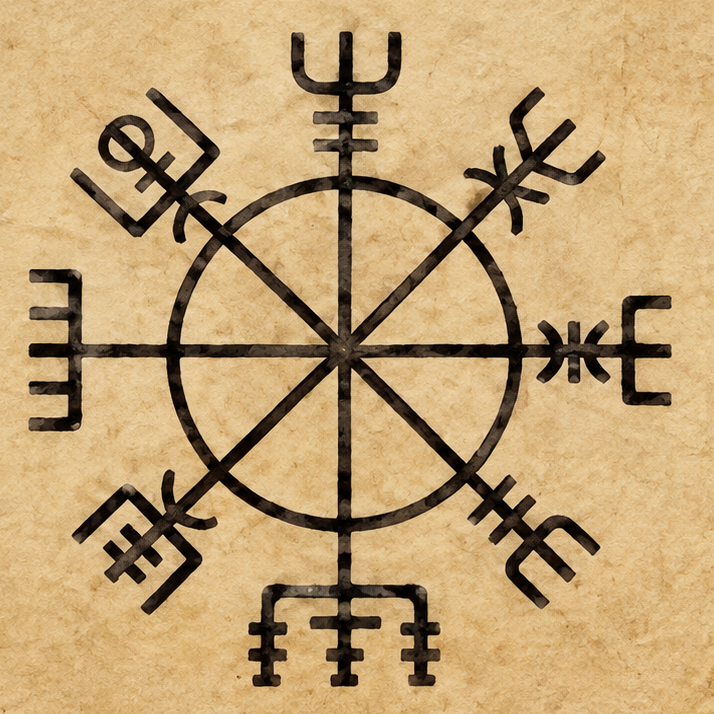
Long before there was an Unsettled Man, there was a symbol. I knew it as the Vegvísir, the Viking compass: a wayfinder carried by men who crossed hostile seas and unfamiliar country, a mark meant to keep a traveler from losing his way when the weather closed in and the road disappeared.
It was a good story. Maybe too good. Years later I learned that the history was considerably messier. The Vegvísir that survives in the historical record is not a Viking Age navigational instrument. It appears in a nineteenth-century Icelandic magical manuscript, centuries after the longships. The familiar story had taken a real symbol, attached it to a more romantic past, and carried that version into tattoos, jewelry, books, and modern mythology.
For a while, that felt like discovering that something I had chosen for its meaning had been built on the wrong history. Then the disappointment gave way to a better question: if the story was wrong, was the truth I had taken from it wrong too?
No. The myth did not survive scrutiny intact. The truism did. Human beings need bearings. We need some way to know which direction we are facing when the route becomes uncertain, the weather changes, the map stops matching the ground, and the confidence that carried us this far turns out not to be the same thing as wisdom. That, more than anything else, became the idea behind Unsettled Man.
The Clean Compass and the Jagged One
Look up the Vegvísir and you will usually find something neat enough to print on a pendant: balanced arms, deliberate marks, a center from which everything radiates with geometric confidence. Mine does not look like that. Mine is jagged. The lines wander. The proportions are imperfect. It looks less like an artifact reproduced from a manuscript and more like something scratched out by a man trying to remember which way home is.
I have come to prefer it that way. A perfect symbol suggests a perfect system: establish north, hold the bearing, follow the line. A life does not cooperate. We take jobs because we need money and discover careers. We build careers and discover that work can consume the very things we thought we were building it for. We make decisions for reasons that seemed perfectly sound at the time and later wonder how we could have been so certain. We inherit ideas that help us survive one stage of life and then discover they do not help us live the next one.
We stay too long. We leave too soon. We mistake stubbornness for strength, silence for restraint, exhaustion for devotion, control for responsibility, and being needed for being loved. Sometimes we do what we know is right and still lose. Sometimes we do what we know is wrong because knowing better and doing better are not the same skill. Sometimes the road bends because life changed around us. Sometimes it bends because we did.
The clean version is the mythology. The jagged one is the life.
That difference matters because Tenet 15 is not really about arriving at the end and deciding what we would like people to say about us. It is about looking honestly at the line we have drawn while trying to find our way. Legacy is not a destination waiting at the end of the route. It is the trail created by the search.
The Search for Home
Home is an easy word until you try to define it. It can mean a house, a town, a family, a person, a memory, a room where you finally stop bracing for something. None of those definitions is complete. Houses are sold. Towns change. Children leave. Parents die. Careers end. Relationships evolve. Bodies fail. Places that once seemed permanent eventually belong to somebody else.
The home I mean here is less a location than an alignment. It is the place where what you say matters and how you actually live begin pointing in roughly the same direction. Where the people you claim to love can see evidence of that love in your choices. Where work serves a life instead of becoming an excuse not to have one. Where strength does not require making someone else small. Where responsibility does not become a weapon. Where you can look at yourself without needing an elaborate argument about why everything was somebody else’s fault. Home is knowing what matters, knowing what belongs to you to carry, and recognizing when you are drifting away from both.
Perhaps that is why the word unsettled has stayed useful. The goal was never to become a Settled Man in the sense of reaching some final condition where the questions stop. They do not. There is always another responsibility, another loss, another opportunity, another piece of ourselves that has not caught up with what the rest of us has learned. The landscape keeps changing. The objective is not to eliminate uncertainty. It is to remain capable of navigating through it without confusing motion with direction.
A man can be unsettled without being lost. He can also be very settled and completely off course.
We Lose Our Way
This is where the pleasant version of the wayfinding metaphor has to end. Getting lost is not automatically noble. Wrong turns are not transformed into wisdom merely because we survived them. Some mistakes become funny stories. Others cost money, years, trust, health, opportunity, or relationships. Some change another person’s life. Some become part of a family. Some travel forward into the next generation until somebody finally recognizes the pattern and decides it will stop with him.
A man can walk confidently in the wrong direction for a very long time. Confidence does not improve the bearing. Neither does sincerity. One of adulthood’s more uncomfortable lessons is that intent and consequence are not the same thing. We can believe we are providing for a family while disappearing into work. We can believe we are being strong while teaching everyone around us to conceal bad news. We can call control protection, avoidance peace, enabling loyalty, anger conviction, and sacrifice something noble even when everyone except us is paying for it.
We are exceptionally good at explaining ourselves to ourselves. We know the pressure we were under. We know what we meant. We know what we feared, what we were trying to protect, why the decision seemed reasonable, why this time was different, why we did not have a better choice. Context matters. Intent matters. But other people still live with what happened.
That is why legacy is harsher than reputation. Reputation can be managed. It can be burnished by charm, status, selective memory, public generosity, a good title, a good story, or the fact that most people never see us under sustained pressure. Legacy escapes that control because it exists in the effects other people have to carry. A man can be admired at work and feared at home. He can be considered generous by strangers while his family remembers walking on eggshells. He can be respected for competence while leaving every difficult emotional task to someone else.
Reputation is what people think they know about you. Legacy is what your life caused.
The difference between those two things is where self-image stops being useful. Eventually the question is not whether we can explain the route. It is whether we are willing to look at where it led.
The Past Does Not Move
There is a comforting version of self-improvement in which every mistake becomes material for a redemption story. Recognize what happened, apologize, do the work, become better, close the chapter. Sometimes life gives us that arc. Sometimes it does not.
Some apologies come too late, and some are too small for the damage they are meant to address. Sometimes the person who deserves the apology is gone. Sometimes the apology can be heard and cannot be received. Sometimes it is received and forgiveness still does not follow. Sometimes a relationship cannot be restored. Sometimes it should not be. Some trust, once destroyed, does not come back.
Some damage can never be undone. Actions lie in the past where they are no longer available for editing. No amount of regret can make an event unhappen, and no amount of later goodness retroactively erases earlier harm. We can change what happens next. We cannot change what already happened.
This is where accountability becomes more demanding than remorse. An apology can be necessary without being sufficient. Restitution can be owed without buying absolution. Understanding why you did something does not require the person affected by it to participate in your redemption. Forgiveness is not a debt that becomes payable because the offender has finally become self-aware.
Where repair is possible, repair is an obligation. Where it is not, the obligation changes. Tell the truth about what happened. Make restitution where restitution can still be made. Accept consequences that belong to you. Stop repeating the behavior. Refuse the temptation to turn remorse into another story in which you remain the central character.
This is part of what breaks legacy: not that men make mistakes, because imperfection is unavoidable, but that they defend the pattern after the evidence is clear. They keep insisting that intent should outweigh impact. They explain the damage instead of interrupting it. They confuse feeling bad with becoming different.
The opposite error is surrender. A man decides that because he did something he cannot undo, nothing he does afterward can matter. That can sound like accountability. It can even feel appropriately punishing. But it is another form of evasion, because it uses the unchangeable past as permission to abandon responsibility for the changeable present.
Becoming better does not make you innocent of who you were. It makes you responsible for who you become next.
The trail behind you remains. Some stretches may always be ugly. Some landmarks may be places you would give almost anything not to have visited. The scar is real. So is the correction. If the line is still being drawn, you still have a say in its direction.
A Life Leaves Evidence
I have spent much of my working life around systems, projects, machines, organizations, and problems that needed to be understood well enough to fix. Mechanical problems have a certain honesty to them. A failed system does not care about the explanation. Something is not working. Find the evidence. Trace the failure. Correct what can be corrected. Test again.
Human beings are harder because we can look directly at the evidence that something in our lives is failing and spend years defending it. Competence in one domain does not grant competence in another. A man can solve complicated problems all day and remain baffled by the ones he carries home. He can be dependable to an organization and unavailable to the people he loves. He can build a career around being the person with answers and become almost incapable of admitting when he does not have one.
Age has a way of reducing the usefulness of those defenses. You accumulate enough outcomes to see patterns that intention once obscured. You discover that providing and being present are related but not interchangeable, that responsibility can quietly become identity, that money is useful precisely because other things matter more, and that being right can consume enormous amounts of energy that might have been better spent being useful.
This is not mastery speaking from the summit. It is navigation from somewhere on the trail. That is all these Tenets were ever meant to be.
The Fourteen Bearings
The first fourteen Tenets are not commandments and they are not achievements to be checked off before a man earns the right to call himself good. They are bearings: reference points for those moments when circumstances change, certainty fails, or the man we are becoming begins to drift away from the man we intended to be.
Tenet 15 is different because it turns those bearings around. Instead of asking what we believe, it asks what those beliefs produced. The earlier Tenets stop being ideas here. They become evidence.
Tenet 1: Strength Through Balance
What did your strength produce? Did it protect, steady, build, endure, and make room for the strength of others, or did it eventually become another name for ego, domination, or the inability to admit weakness?
Tenet 2: Integrity
Did your word become something people could rely on when keeping it was inconvenient? Integrity is easy to admire in theory. Legacy records what happened when honesty became expensive.
Tenet 3: Spiritual Without the Chains
Did spiritual freedom make you more open, humble, compassionate, and willing to live with mystery, or did it merely free you from every standard except the ones you preferred?
Tenet 4: Financial Maturity
Did money become a tool for stability, opportunity, generosity, and stewardship, or a source of fear, control, status, and chaos that other people had to absorb?
Tenet 5: Family First
Did your family experience your priorities the way you described them? Provision matters. So does presence. The people we work so hard for should not receive only what remains after everything else has taken its share.
Tenet 6: Community Matters
Did concern ever become usefulness? Did you show up, contribute, teach, repair, serve, or make some corner of the world function better, especially when nobody was keeping score?
Tenet 7: Love and Respect for All Relationships
Did people feel safe being fully human around you? Love that exists only as intention can still leave another person lonely, diminished, or afraid to tell the truth.
Tenet 8: Strength in Compassion
Did compassion survive contact with people who were inconvenient, unfamiliar, powerless, or unable to offer anything in return? Principles become legacy when they cost something.
Tenet 9: Reject Extremism
Did you keep your judgment when anger, tribe, fear, certainty, and belonging all invited you to surrender it? Did disagreement make you curious, or merely more convinced of your own virtue?
Tenet 10: Emotional Intelligence
Did you learn to handle your inner life without making everyone around you pay for it? Did difficult conversations become safer because you were there, or more dangerous?
Tenet 11: Lifelong Learning
Did age make you wiser or merely more certain? Could reality still change your mind, or did experience eventually become an argument for why you no longer needed to listen?
Tenet 12: Strength Without Ego
Did younger men become more capable around you, or merely learn another performance of masculinity they would someday have to unlearn?
Tenet 13: Brotherhood Over Toxicity
Were you the kind of friend who could stay, listen, laugh, tell the truth, and refuse to help another man hide from accountability? Brotherhood should make men better, not merely more comfortable.
Tenet 14: Environmental Stewardship
What happened to the things temporarily placed in your hands: land, property, systems, resources, authority, knowledge, responsibility? Did you leave them healthier, depleted, or simply somebody else’s problem?
That is why legacy is not simply Tenet 15. It is the final accounting of the other fourteen.
Not because legacy sits above them, but because every one of them eventually becomes consequence. A belief held sincerely but never practiced may have mattered to us. The world around us experienced the practice.

Legacy Is Built on Ordinary Days
We tend to imagine legacy as something constructed deliberately near the end: an inheritance, a body of work, a company, a reputation, a lesson delivered with enough gravity that everybody remembers it. Most legacy is built far more quietly. It accumulates in ordinary conduct, on days that do not feel important enough to become stories.
It forms in how you respond when responsibility is inconvenient, whether people bring you bad news early or wait until there is no choice, whether your home becomes calmer when you walk in or more tense, whether your standards apply upward and downward as well as outward, and whether an apology is followed by changed behavior. Children, partners, coworkers, friends, neighbors, and younger men learn from what repeats. Over time, repetition becomes pattern, pattern becomes expectation, expectation becomes memory, and memory becomes part of how legacy actually gets built.
This is why fame has so little to do with it. A man can disappear from public memory within a generation and still alter hundreds of lives. A child treats his own children differently because of something his father taught him. A worker becomes a better leader because someone once trusted him with responsibility instead of humiliating him for not already knowing. A friend tells another friend an uncomfortable truth because somebody once cared enough to do the same. A family pattern that survived for generations finally stops. A system keeps working long after anyone remembers who designed it.
Most of those effects will eventually lose our names. That does not make them smaller. There is freedom in accepting that what matters about a life may survive without anyone remembering who started it.
What Time Does to the Question
When we are young, the question of legacy often arrives disguised as ambition. Will I matter? Will anyone notice? Will I accomplish something significant enough to prove that I was here? There is nothing especially shameful about that hunger. A young man is trying to establish himself in a world that has not yet given him much evidence that he belongs in it.
Midlife changes the accounting. Recognition matters less than responsibility. The questions become more practical and more personal. Did I provide? Was I dependable? Did all this work actually build something? Were the sacrifices worth what they cost? The man who once wanted to prove that he could carry weight may discover that he has been carrying so much for so long that he no longer knows who he is without the load.
Later, the frame changes again. Accomplishment begins to sound less important than echo. You notice what traveled forward. You see pieces of yourself in the way other people solve problems, handle money, argue, apologize, work, worry, love, or avoid love. Some of those echoes are gratifying. Others are humbling. Legacy changes with age because time strips away much of the performance and leaves consequence easier to see.
The question gradually stops being, What did I achieve? and becomes, What did my life make easier for others, and what did it make harder?
The Things We Cannot Keep
There is another part of aging that belongs in any honest discussion of legacy. For much of adult life, men are encouraged to define themselves through capability. Can I provide? Can I carry it? Can I fix it? Can I solve the problem? Can I protect the people around me? Can I still do the work? Capability matters. Remaining strong, mobile, sharp, useful, and independent for as long as reasonably possible is worth the effort.
But capability is not permanent. The body eventually begins renegotiating the contract. Recovery takes longer. Injuries accumulate. Strength recedes. A task that was once routine becomes difficult. Someone younger sees something faster. Children who once depended on us begin doing things for us. The direction of care can reverse.
This is where a philosophy built only around usefulness can become cruel. If a man’s worth depends entirely on what he can produce, lift, earn, repair, decide, or provide, then age does more than reduce capability. It dismantles identity. The answer cannot be to surrender early, but neither can it be to treat every limitation as an insult that must be defeated.
The Stoics were useful on this point because they distinguished between what remains ours to choose and what does not. The Buddhist tradition approaches the same terrain from another direction: impermanence is not evidence that something went wrong. Bodies change. Roles end. Status evaporates. People leave. What we possess eventually changes hands. Attachment to the demand that these things remain exactly as they were creates suffering on top of loss.
Acceptance is not passivity. If strength can be preserved, preserve it. If treatment helps, seek it. If a habit is shortening your independence, change the habit. Adapt the tool, the house, the workout, the expectation, the schedule. Use the cane if the alternative is falling because pride objected to the optics. There is nothing noble about surrendering capability that could reasonably be maintained.
But there is also nothing strong about demanding that reality negotiate with our ego. Eventually some things will not come back. The work then is different: adapt without surrendering agency, accept without pretending loss does not hurt, and learn to receive help without making the people who love you pay for the humiliation of being needed in a new way. That too becomes legacy. How a man relinquishes control matters. Whether he allows another generation to lead matters. Whether he can remain interested in a world that no longer centers him matters. Whether the people caring for him experience gratitude, bitterness, humor, cruelty, humility, or endless combat matters. There is a final kind of strength in letting go without making everyone else drag the thing out of your hands.

Memento Mori
Memento mori. Remember that you will die.
The phrase has accumulated its own imagery: skulls, extinguished candles, old paintings, Latin mottos, Stoic quotations. Those things can be beautiful. None is the reason mortality matters here. Death matters because it places a hard limit on something we spend most of our lives assuming will still be available tomorrow, agency.
While we are alive, some portion of the trail remains unwritten. Maybe decades. Maybe not. We do not know. But while the line is still moving, we can make the call, stop repeating something, admit that a belief has failed, teach what took us thirty years to learn, finish the work, put down a burden that was never ours, repair what can still be repaired, make restitution, become present, ask for help, forgive where forgiveness is ours to give, or simply refuse to draw tomorrow’s line in yesterday’s direction.
None of those choices guarantees the outcome we want. The apology may still be refused. The relationship may still end. The business may fail. The child may choose another path. The person we taught may ignore the lesson. The damage may remain. Agency is not control. It is only the ability to choose what we do next. Death removes even that.
Afterward, other people hold the stories. They will remember some things and forget others. They will misunderstand us, idealize us, resent us, forgive us, perhaps all at once. Stories will change. Facts will disappear. Eventually even the stories may disappear. We will not be there to correct any of them.
Death ends authorship. It does not end consequence.
That is the useful force of memento mori. Not morbidity. Urgency. The editing window is finite.
Legacy Is Not Inheritance
Inheritance is something we transfer. Legacy is what people are left living with. Money can be inherited. Property can be inherited. So can habits around money, fear of conflict, confidence in one’s ability to solve problems, an instinct for generosity, suspicion of authority, tenderness, rage, curiosity, resilience, silence, humor, shame, and the expectation that love either stays when things get difficult or disappears.
Some of that residue is deliberate. Much of it is not. We teach people what is normal simply by being around them long enough. Children learn what partnership looks like before anyone explains it. Coworkers learn whether bad news is safe to deliver. Friends learn whether vulnerability will be met with attention or turned into ammunition. Younger men learn whether strength includes apology by watching what older men do after they are wrong.
This is why legacy can survive without a name. A family behaves differently because somebody broke a pattern two generations earlier. A company retains a standard because a person who is no longer there insisted that shortcuts were not acceptable. Someone treats a frightened employee with dignity because years ago a good supervisor did the same for him. A repaired house outlives the hands that repaired it. A lesson moves through people who no longer remember where they first heard it.
Fame is optional. Consequence is not.
The Final Accounting
At some point the questions become less flattering. Did I take care of the people I was responsible for? Was I dependable? Was all that work worth what it cost? Who became stronger because I was here? Who had to become stronger because of me? What patterns did I inherit? Which did I repeat? Which ended with me? What did I build? What did I neglect while I was building it? Where did I know better? Where did I eventually learn better?
Those are not funeral questions. They are living questions. Their value lies precisely in asking them while something can still change.
Legacy is sometimes described as the long shadow of a life. I understand the appeal, but shadows depend too much on where someone else is standing. I prefer residue. Or trail. Both are less flattering and more useful. They include the things we intended to leave and the things we did not. They acknowledge that some of what follows us will be good, some harmful, much complicated, and nearly all of it less controllable than we would prefer.
Legacy is the accumulated consequence of a life.
The good and the harm. The things built and the things broken. What was repaired and what could not be. Knowledge transferred. Opportunities created. Burdens handed to someone else. Responsibilities accepted. Responsibilities avoided. People strengthened by our presence. People forced to become stronger because of what we did to them. Places cared for. Resources wasted. Patterns continued. Patterns interrupted. Apologies accepted. Apologies refused. The apology that never had the chance to be made.
All of it.
Legacy is not a trophy awarded for finishing life well. It is not proof that the good canceled the bad, or that the bad invalidated everything that followed. It is the evidence that remains after our explanations are no longer available to accompany it.
You May Never Reach Home
Perhaps the final trick of the wayfinder is that there may be no moment when we arrive and declare the journey complete. Home at twenty is not home at forty. Home before children is different from home after them. Home while building a career is different from home when the career no longer defines the day. Home changes when parents age, when children leave, when relationships deepen or end, when the body begins imposing limits ambition once ignored, and when things that once seemed urgent reveal themselves to have been temporary.
Maybe the objective was never arrival. Maybe it was course correction. Notice the drift. Check the bearings. Correct. Continue.
That is less heroic than conquering the horizon. It is also more honest. The man who insists he has finally arrived is often the man who has stopped looking at the compass.
And eventually, even the idea of home may simplify. As capability narrows and possessions change hands, as roles fall away and the world demonstrates that it can continue without our management, home may become little more than knowing what matters while everything that does not last begins falling away.
Leave Good Bearings
The Vegvísir means something different to me now than it did when I first chose it. That seems appropriate. Symbols should be allowed to grow with us.
I once saw a promise in it: I will not lose my way. I no longer believe that is a promise any honest person can make. We lose our way. We follow the wrong people. We believe the wrong things. We confuse success with direction. We hurt people, get hurt, overcorrect, retreat, start again, and sometimes discover years later that the thing we were pursuing was never home at all.
The better promise is smaller and harder: When I realize I am lost, I will look for my bearings again. That is what the jagged lines mean to me now. Not certainty. Not protection from every wrong turn. Not a magical guarantee that the road will reveal itself. A reminder to keep asking where home is and whether the direction of travel still deserves the miles.
Eventually someone travels after us. Children, perhaps, but legacy is larger than blood. Friends. Coworkers. Students. Employees. Neighbors. People we helped briefly and never saw again. People who will learn from our mistakes without ever knowing our names. They have their own terrain, their own weather, their own bad maps, their own imperfect idea of home.
We cannot give them the completed map because there is no completed map. We cannot spare them every wrong turn, and we should be suspicious of any man who claims he can. What we can leave are bearings: here is something that mattered; here is something I believed that turned out not to be true; here is where pride led me; here is what happened when I kept going even after I knew I was heading the wrong direction; here is something I managed to repair; here is something I never could; here is a place where compassion worked better than certainty; here is a mistake you do not need to repeat simply because I did. Do better with it than I did.
Maybe that is the most useful legacy available to any of us. Not a demand that someone follow our trail, but enough evidence from the journey to help the next traveler recognize his own direction.
The popular Viking story attached to the Vegvísir was not the history I thought it was. The symbol survived the correction. So did the truth I needed from it. When the weather closes in, when the map fails, when the person you were is no longer sufficient for the terrain in front of you, you need some way to know which direction you are facing.
The first fourteen Tenets are bearings. The fifteenth is the trail they leave behind.
You will not finish the map.
Leave good bearings.
Explore the Legacy Cluster
Legacy Isn’t Inheritance, It’s Residue
Inheritance is transferred. Legacy is lived with: the habits, standards, wounds, strengths, expectations, and patterns that continue after us.
How Legacy Actually Gets Built
Why ordinary repetition matters more than grand declarations, and how daily conduct quietly becomes memory.
What Breaks Legacy
How trust erodes or shatters, why remorse is not repair, and why refusing to correct course can become more damaging than the original mistake.
Legacy Changes With Age
How ambition, responsibility, capability, decline, acceptance, and mortality change what legacy means across a lifetime.
Continue the Framework
Previous Tenet: Environmental Stewardship
Tenet 14 looks at what a man leaves behind in the physical world, in the places, systems, resources, and responsibilities that pass through his hands.
Return to the 15 Tenets
See the complete framework and how the fifteen Tenets connect.
Start Again: Strength Through Balance
The framework returns to where it began: proportion, discipline, restraint, and the work of staying oriented in ordinary life.