
Emotional control is good.
A man who is ruled by every passing feeling becomes difficult to trust. His anger enters the room before he does. His fear makes decisions and calls them instinct. His shame becomes blame. His frustration becomes everyone else’s weather.
A man should be able to pause, think, choose his words, and step away before he causes damage. He should be able to feel anger without handing it the steering wheel, feel fear without letting it run the meeting, and feel grief without turning it into cruelty or distance.
But emotional control can become distorted too.
A man can become so proud of not being ruled by emotion that he loses honest access to himself. He does not explode, but he also does not grieve. He does not panic, but he cannot ask for comfort. He does not burden anyone, but he also does not allow anyone to know him beyond his usefulness.
He calls it control.
Sometimes it is starvation.
This page supports Tenet 1: Strength Through Balance. Emotional control is necessary, but it must remain in proportion to honesty, connection, grief, tenderness, and the ability to receive support.
It also connects directly to Tenet 10: Emotional Intelligence, where the broader work of recognizing, understanding, and using emotion well belongs.
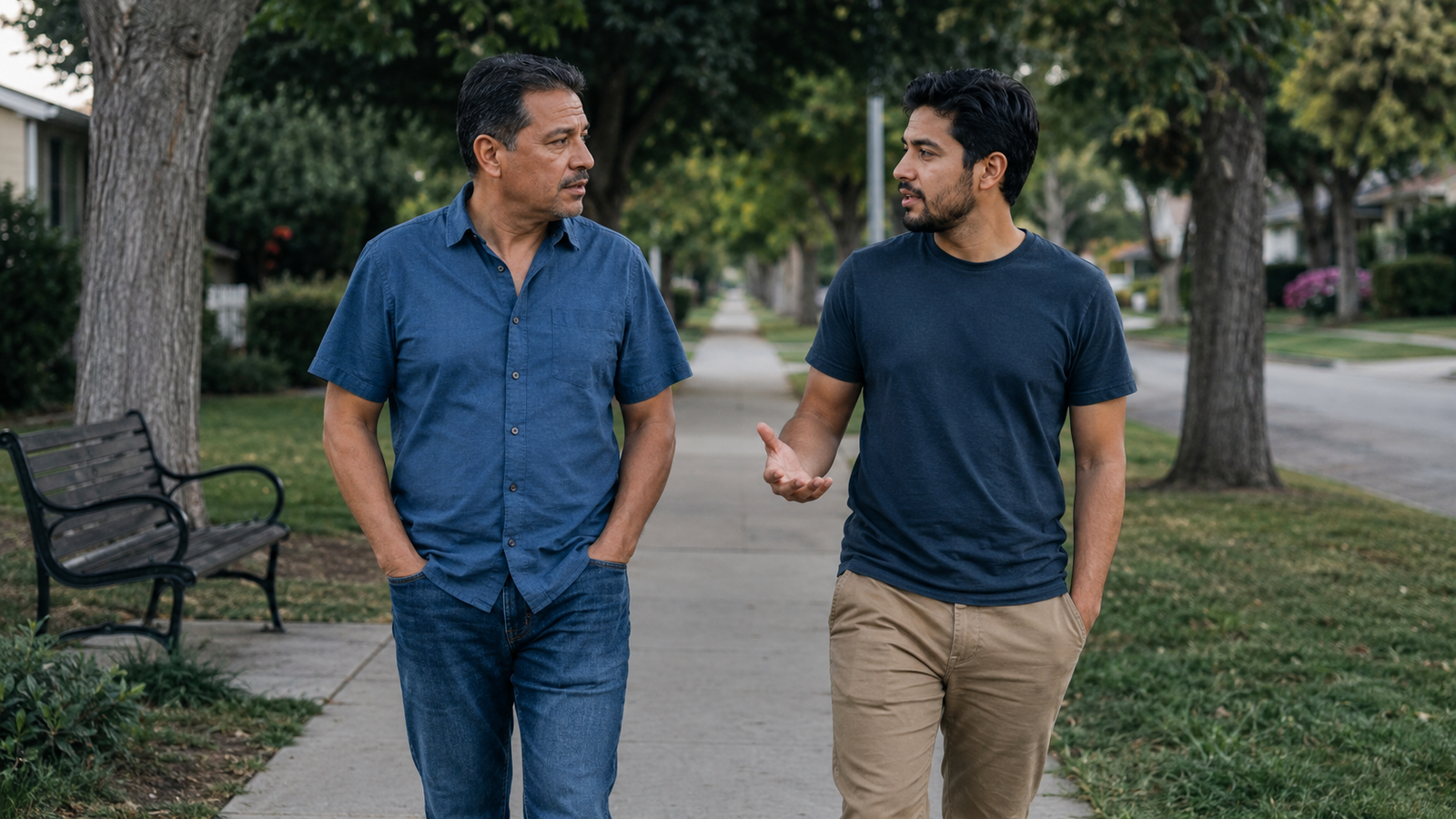
Emotional Control Means Choice
Control is not the enemy.
A man needs enough control not to terrify his family because he had a bad day. Enough control not to turn every irritation into a speech. Enough control not to treat a partner, child, coworker, friend, or stranger like an emotional punching bag.
There are thoughts that should remain thoughts. The angry text does not need to be sent. The sarcastic comment does not need to be spoken. The child does not need an adult wound dropped on small shoulders because Dad had a difficult afternoon.
Control creates space between impulse and action.
That space is where character lives.
A man without that space is not more authentic. He is simply unsafe with better vocabulary.
Control should preserve your emotional life
Regulation is not starvation. A man needs enough access to feeling to recognize loss, attachment, fear, relief, joy, and the truths those emotions reveal.
Suppression Is Storage, Not Mastery
Suppression can look almost identical to control from the outside.
The man stays calm. He works, provides, fixes the problem, attends the funeral, handles the appointment, and tells everyone he is fine. He may appear steady because nothing visibly spills.
Inside, he may be storing grief, fear, loneliness, shame, exhaustion, or resentment because he never learned what else to do with it.
Stored emotion does not disappear. It leaks into sarcasm, distance, control, irritability, overwork, alcohol, food, screens, isolation, compulsive exercise, or the mysterious male condition known as “I’m fine,” delivered in a tone that makes everyone nearby prepare for impact.
| Emotional control | Emotional suppression |
|---|---|
| Recognizes the feeling | Refuses to acknowledge the feeling |
| Chooses the time and form of expression | Avoids expression indefinitely |
| Protects other people from impulsive harm | Protects the man from being known |
| Creates clarity and steadiness | Creates numbness, distance, or hidden pressure |
| Allows repair and connection | Leaves others guessing |
| Uses restraint as a tool | Uses silence as a permanent hiding place |
Control chooses.
Suppression hides.
Anger Should Not Translate Everything
Many men were not taught to avoid every emotion.
They were taught to avoid every emotion except anger.
Sadness looked weak. Fear looked weak. Tenderness looked suspicious. Shame had to be hidden. Grief had to be shortened. Loneliness had to be joked away.
Anger could still look masculine, so every other emotion learned to wear its jacket.
A man is hurt, but it comes out as anger. He is frightened, embarrassed, grieving, ignored, powerless, or worried, but the only tool close at hand is a hammer, so every emotional problem gets treated like a nail.
Anger itself is not bad. It can reveal violation, injustice, fear, grief, or a boundary that needs protection. It can wake a man up and move him toward necessary action.
But anger should not be the only translator.
A man needs enough emotional language to say, “I was worried,” “That embarrassed me,” “I felt dismissed,” or “I am more hurt by this than I expected.”

Calm Can Be a Wall or a Bridge
Some men do not explode. They freeze.
They become calm in a way that is less like peace and more like a locked building. They speak evenly, avoid visible emotion, and may believe this proves maturity.
Sometimes it does.
A calm man can de-escalate, listen, lead, comfort, think clearly, and remain steady while other people are struggling. Calm can be a genuine gift.
But calm becomes a costume when it is used to avoid intimacy, accountability, vulnerability, or an uncomfortable truth. A man can hide behind calm the way another man hides behind rage.
He can punish with silence. He can use a measured voice to imply everyone else is irrational. He can turn every difficult conversation into a courtroom where feelings are inadmissible and he appointed himself judge.
A balanced man does not use calm to disappear.
He uses calm to remain present.
Practical standard: Feel what is real. Do not make everyone else survive the first wave. Then return with enough honesty that the people who matter are not forced to live on guesswork.
Feelings Are Information, Not Orders
A feeling is not automatically a fact.
Feeling disrespected does not prove disrespect occurred. Feeling afraid does not always mean danger is present. Feeling rejected does not prove someone abandoned you. Feeling guilty does not always mean you did something wrong. Feeling angry does not automatically make you righteous.
Feelings can be old, distorted, exaggerated, or strengthened by hunger, fatigue, pride, alcohol, poor sleep, past wounds, or the fact that you read the news for forty minutes and now humanity looks like a failed group project.
But feelings are still information. They tell a man that something is happening inside him.
The mature response is investigation rather than obedience or denial:
- What am I actually feeling?
- What triggered it?
- What might be underneath the first reaction?
- Is this about the current moment or an older wound?
- What part of this feeling is supported by the facts?
- What action would be useful?
- What action would only create damage?
Feel it. Name it. Test it. Choose.
That is emotional control with awareness.
Emotional Honesty Is Not Emotional Dumping
Some men avoid honesty because they imagine the only alternative to silence is chaos.
They picture every old wound, fear, accusation, regret, and grievance pouring out at once until the conversation qualifies as a municipal cleanup project.
That is not honesty. That is dumping.
Dumping says, “Here is everything I feel. You deal with it.” Honest expression says, “Here is what is happening in me, and I am trying to handle it responsibly.”
A disciplined man can say:
- “I am angry, and I need a few minutes before I answer.”
- “That hurt more than I expected.”
- “I am worried, and I do not want to take it out on you.”
- “I am overwhelmed and need help thinking this through.”
- “I am not ready to talk yet, but I will come back to it.”
- “I realize I have been distant. That is on me.”
Those are not weak sentences.
They are controlled sentences.
The deeper practice is developed further in Emotional Control Without Shutting Down.
Where Emotional Starvation Shows Up
Emotional starvation rarely stays contained inside a man. It changes how he relates, works, rests, and inhabits his own body.
In relationships
A man may be loyal, useful, hardworking, and physically present while remaining emotionally unreachable. His partner has to become a detective. His children learn to read his mood but not ask about it. His friends keep things shallow because every serious question is met with a joke or a change of subject.
He may think he is protecting everyone from his burdens. Eventually, people stop knocking on a door that never opens.
Privacy is fair. Permanent mystery is not intimacy.
At work
Work often rewards emotional compression. Stay professional. Stay calm. Solve the problem. Do not bring the entire inner weather system into the meeting.
That is reasonable. Work is not therapy with invoices.
But men often absorb pressure all day and bring the compressed version home, where it leaks onto people who did not cause it. Professional control still requires a place to process stress, address unfairness, set limits, and admit when the workload has become unsustainable.
The same principle applies to responsibility without resentment. Silence does not make an unhealthy load healthy.
In the body
Men often try to keep emotion in the head. The body disagrees.
Stress may appear in the shoulders, jaw, sleep, blood pressure, appetite, headaches, fatigue, irritability, libido, or the sudden need to reorganize the garage instead of having a conversation.
This does not mean every physical problem is emotional. Bodies are complex, aging is rude, and sometimes a knee is simply a knee being dramatic.
But a man who wants to train for the life he actually lives should understand that emotional strain is still strain.
Grief Requires More Than Function
Grief exposes false control.
A man can function through loss. Sometimes he must. Someone has to handle arrangements, paperwork, calls, travel, bills, family dynamics, and the strange administrative cruelty that often surrounds death.
There is strength in functioning.
Functioning is not the same as grieving.
A man may handle everything and never let the loss reach the places it needs to reach. Months or years later, he may feel hollow, angry, detached, or unable to explain why ordinary things suddenly hurt.
Grief arrives in songs, smells, tools, recipes, holidays, empty chairs, and jokes nobody else remembers. It rarely obeys the calendar a man would prefer.
He does not need to perform grief for public approval. He does need somewhere honest to put it.
That is not weakness.
It is respect for love after the body has left the room.
Build Places Where Truth Can Go
A man does not need to share everything with everyone. That would be unwise, exhausting, and occasionally a terrible dinner.
He does need at least a few places where the performance stops.
A spouse or partner. A trusted friend. A brother. A counselor. A mentor. A journal. Prayer. A long walk. A doctor when stress is becoming physical. A therapist when old patterns keep winning.
A safe outlet is not permission to unload without restraint. It is a place where truth can be spoken, examined, and carried responsibly.
A man should not wait until he is breaking to build the places where honesty can go.
A Practical Reset
Do not announce the beginning of your emotional rebirth. Nobody needs the press release.
Start with one honest correction.
- Notice the physical signal. Tight jaw, shallow breathing, heat, withdrawal, or the urge to attack may arrive before clear language.
- Name the feeling more precisely. Move beyond fine, tired, and angry. Try worried, embarrassed, disappointed, lonely, ashamed, overwhelmed, or hurt.
- Separate feeling from fact. Ask what happened, what you assumed, and what remains uncertain.
- Choose the immediate response. Speak, pause, leave briefly, write it down, ask a question, or do nothing until the first wave passes.
- Return to the conversation. A pause is useful only when it does not become disappearance.
- Repair what you damage. Control will fail sometimes. Apologize, correct the behavior, and learn from the pattern.
The goal is not flawless calm.
The goal is repairable strength.
A Better Standard
Control your emotions.
Do not make anger a family weather system. Do not confuse authenticity with acting out. Do not dump every feeling into the room and call the wreckage honesty.
But do not starve the emotional life either.
Do not bury grief until it becomes bitterness. Do not use calm as a wall. Do not become unreachable and call it strength. Do not make the people who love you guess forever.
A balanced man is steady enough to be trusted and honest enough to be known.
He feels without flooding the room.
He controls himself without disappearing from himself.
That is harder than rage.
It is stronger than numbness.
It is emotional control with a pulse.
Continue Building Balanced Strength
- Tenet 1: Strength Through Balance
- Consistency Beats Motivation Every Time
- When a Good Thing Becomes a God
- Discipline Without Joy Is Just Punishment
- Save Money Without Forgetting to Live
- Train for the Life You Actually Live
- Responsibility Without Resentment
Continue With Emotional Intelligence
Continue through the framework: Explore all 15 Tenets for Positive Masculinity.