
A man should train for the life he actually has.
Not the body he had at twenty-five. Not the life he performs online. Not the imaginary future in which his schedule is clear, his joints are quiet, his sleep is perfect, and nobody needs anything from him.
The life he actually lives may involve stairs, groceries, travel, yard work, grandchildren, long drives, home repairs, job stress, aging parents, bad sleep, old injuries, and the humbling discovery that getting off the floor has become an event with several stages.
That life may not care what he used to bench. It may care whether he can carry two bags of mulch, walk through an airport, climb a ladder safely, help move a couch, play with a child, or finish a long day without his body filing a formal complaint.
Training matters because the body participates in almost everything a man values. But training should serve the life. The life should not be forced to orbit the training.
This page supports Tenet 1: Strength Through Balance. Physical strength is valuable, but like every other strength, it becomes distorted when the tool starts demanding more than the purpose it was meant to serve.
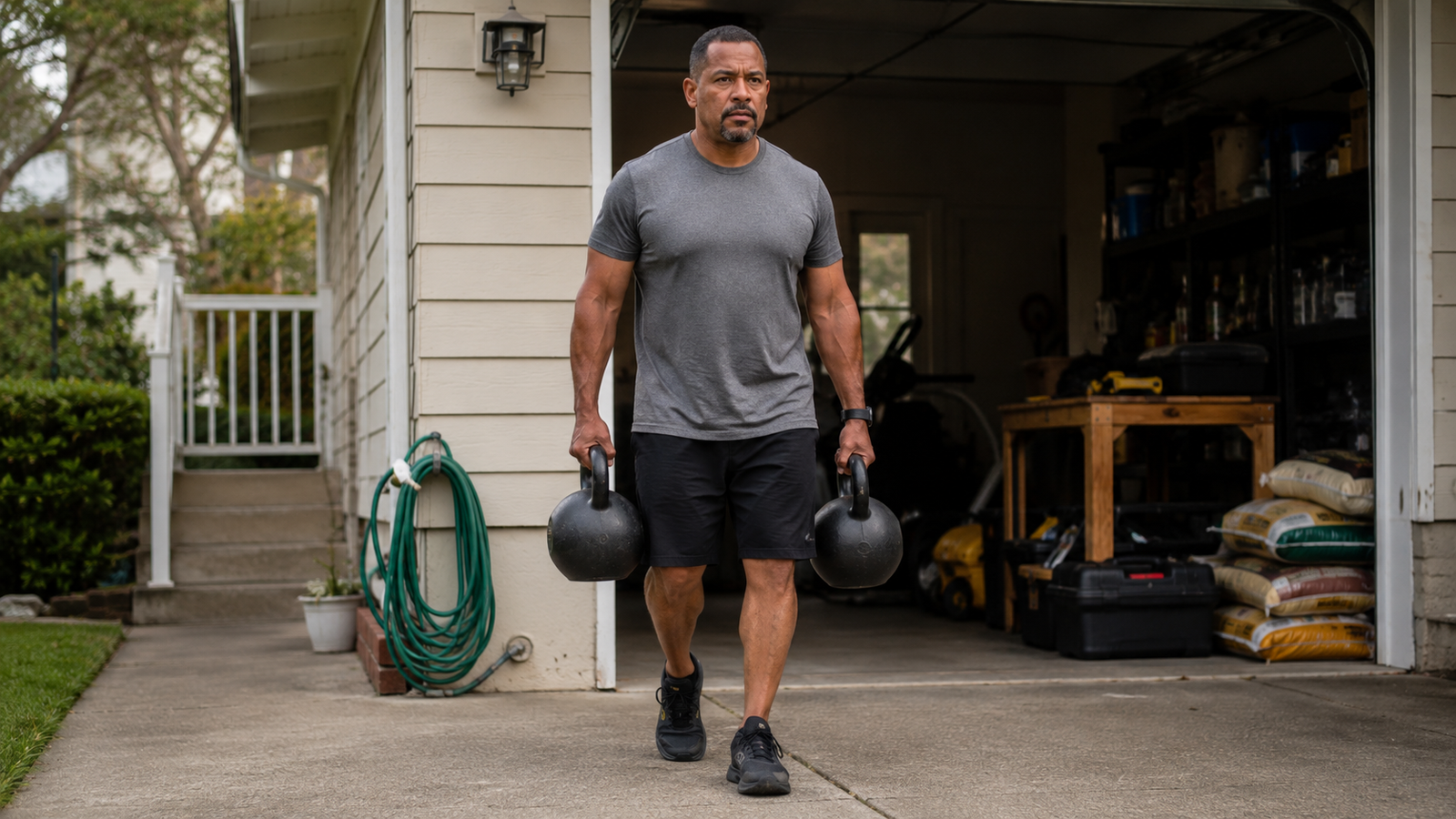
Fitness Should Make Ordinary Life Easier
There is nothing wrong with wanting to look better. A man is allowed to lose the belly, build muscle, improve his posture, wear his clothes with more confidence, and stop being surprised by his own reflection in store windows.
Appearance can be a useful motive. It becomes a weak foundation when it is the only motive.
A man can look fit and still be poorly prepared for his actual life. He can have visible muscle while lacking endurance, mobility, balance, recovery, or the ability to handle awkward movement outside a controlled gym. He can chase one impressive metric while his sleep, joints, blood pressure, relationships, and ordinary energy quietly decline.
Useful fitness asks broader questions. Can you move without fear? Can you carry weight safely? Can you walk distance, climb stairs, get off the ground, recover from effort, and remain involved in the work and people you care about?
A man does not need to become a model. He needs to become harder to sideline.
Practical standard: Training is working when it expands your ability to participate in life. It is failing when life must continually shrink to protect the training.
Train the Body You Have Now
Aging is not an excuse to quit. It is also not permission to train like an idiot.
Many men carry an old picture of themselves in their heads. They remember what they used to lift, how fast they recovered, how little sleep they needed, and how many injuries they could ignore. The memory may be accurate. It is still not the body standing in the room today.
The body you have now is the one that needs leadership. Its knees may be different. Its shoulders may have opinions. Recovery may take longer. Warmups may matter more. Sleep may no longer be an optional hobby. The doctor may not have been making conversation when he mentioned weight, blood pressure, or mobility.
That is not weakness. It is information.
A balanced man does not surrender because the body has changed. He adjusts because he intends to keep using it. He respects what the body can do, pays attention to what it is telling him, and trains in a way that leaves room for another month, another year, and another decade.
Train the Capacities Life Actually Uses
Real life rarely asks for one clean movement under perfect conditions. Grocery bags are uneven. Suitcases twist. Children move. Dogs pull sideways. Ladders wobble. Hills do not adjust their angle. The couch has no handles, and the wet floor does not care about your personal record.
A useful training life develops several kinds of capacity rather than worshipping one.
Strength
Strength makes ordinary work easier. It helps a man lift, carry, push, pull, brace, climb, repair, and assist other people without every task becoming an emergency. Muscle also gives the aging body useful reserve.
Strength should be challenged, but it should not become a daily referendum on masculinity. Reducing a weight, changing a movement, or stopping before an injury is not surrender. The goal is not to prove that the body is unbreakable. The goal is to make it harder to break.
Endurance
Life often asks for sustained effort rather than one dramatic push. Workdays are long. Airports are large. Stress accumulates. Family responsibilities do not care what you trained yesterday.
Walking, hiking, cycling, swimming, rowing, stairs, jogging, or any other repeatable movement can build the ability to keep going. A man does not need to become an endurance athlete. He should be able to move long enough for his strength to remain useful.
Mobility, Balance, and Coordination
Mobility is where pride goes to complain. It is less exciting than adding weight to a bar and more humbling than most men expect. Tight hips, limited shoulders, weak ankles, poor balance, and neglected range of motion eventually restrict more than exercise. They restrict travel, yard work, floor time, stairs, sleep, and independence.
Mobility is not decorative stretching. It is continued access to your own life. Balance and coordination matter for the same reason. A fall is not a character-building experience. It is an expensive reminder that gravity remains undefeated.
Recovery
Recovery is not what happens when discipline fails. Recovery is part of the discipline.
Sleep, rest, food, hydration, easier days, mobility work, medical care, and time away from intensity allow training stress to become adaptation. Without recovery, a man is not steadily building. He is accumulating fatigue and hoping pride can negotiate with biology.
Discipline without recovery and ordinary enjoyment eventually becomes punishment. A man should train hard enough to improve and recover well enough to continue.
Enjoyment
Enjoyment belongs in the plan because a routine a man hates is unlikely to survive his actual life. Walking with someone, hiking, cycling, working in the yard, paddling, dancing badly in private, hitting a bag, playing a sport, or chasing a grandchild can all count as useful movement.
Not every session needs to feel like a heroic struggle performed for an imaginary committee of disappointed ancestors.
Capability Is a Better Scoreboard
Gym numbers can be useful. Weight, repetitions, distance, pace, and consistency help a man see whether he is improving. The problem begins when the number becomes more important than the life it was intended to improve.
| Training focus | What it should provide | Warning that it has become distorted |
|---|---|---|
| Strength | Safer lifting, carrying, work, and physical confidence | Pain and injury are ignored to protect an old number |
| Endurance | Energy for long days, travel, recreation, and recovery | Every session becomes a punishment or public test |
| Mobility | Freedom to bend, reach, climb, turn, and get off the floor | Movement quality is ignored until ordinary tasks hurt |
| Body composition | Better health, movement, comfort, and confidence | Food, mirrors, and the scale control the man’s mood |
| Routine | Reliable habits that survive imperfect weeks | One missed session is treated as total failure |
| Recovery | Adaptation, durability, and the ability to train again | Rest creates guilt and exhaustion is worn as proof |
The best question is not merely, “Did the number go up?” Ask whether life is becoming easier to participate in. Ask whether the body is more capable, more dependable, and less likely to keep you from the people and experiences that give the work meaning.
Pain, Pride, and Good Judgment
Pain is not always a stop sign, but it is always information. Men commonly mishandle it in both directions. Some stop at the first discomfort and never give the body a reason to adapt. Others treat every warning as cowardice and turn manageable problems into chronic injuries.
Effort is different from sharp pain. Soreness is different from damage. Being tired after useful work is different from a joint repeatedly telling you that the current plan is not working.
Listening does not make a man fragile. It makes him attentive. There is nothing admirable about losing months of capability because pride demanded one more set, one more mile, or one more week of pretending nothing was wrong.
Training for life includes protecting the ability to keep training. That may mean warming up longer, changing an exercise, reducing load, doing tedious rehabilitation work, or getting qualified help instead of collecting advice from strangers whose only credential is a dramatic thumbnail.
Build a Routine That Survives Real Life
The perfect routine you quit is not superior to the good routine you continue.
Many plans quietly assume unlimited time, stable sleep, perfect recovery, no family obligations, no work emergencies, and the emotional temperament of a monk who recently discovered pre-workout powder. Then ordinary life interrupts, the plan collapses, and the man decides he failed.
Sometimes the plan failed.
A sustainable routine has enough structure to create progress and enough flexibility to survive contact with reality. It has a normal version for good weeks and a minimum version for difficult ones. It does not require starting over every Monday.
- Choose a minimum you can repeat. Decide what a difficult but functional week still includes.
- Cover more than one capacity. Include strength, regular movement, mobility, and recovery instead of chasing one impressive number.
- Fit training around real obligations. A plan that continually loses to work and family was not designed for your life.
- Progress gradually. Add challenge without turning every improvement into a dare.
- Protect continuity. When illness, travel, injury, or a hard season interrupts the plan, resume at the appropriate level rather than punishing yourself for the interruption.
- Review the result. Ask whether the routine is improving capability, energy, health, and availability outside the workout.
Consistency matters because real progress must survive imperfect weeks. The standard is not never missing. The standard is returning before the interruption becomes a new identity.
Train to Stay Available
A man’s body is personal, but it is not isolated. His health affects his family. His energy affects his work. His mobility affects his independence. His habits teach the people watching him what adulthood and aging look like.
That is not a guilt trip. Illness, injury, genetics, accidents, and plain bad luck exist. A man can do many things well and still suffer. Training does not provide control over every outcome.
It is stewardship of what remains within reach.
Train to remain available to help, travel, play, work, serve, recover, and participate. Train so the people you love receive more than the exhausted remainder of a man who spent all his physical energy proving something to himself.
Responsibility works better when it includes caring for the person carrying the responsibility. Neglecting the body does not make a man selfless. It may simply transfer preventable costs to the people around him later.
Health Is Bigger Than Fitness
A man can track workouts, steps, protein, body fat, supplements, and personal records while ignoring sleep, alcohol, stress, medical appointments, dental care, pain, medications, or the fact that everyone around him finds him increasingly unpleasant.
That is not health. It is selective accounting.
Fitness is one part of a larger system. A man can be muscular and unhealthy, lean and exhausted, disciplined in the gym and reckless everywhere else. Tenet 1 does not ask for one impressive metric. It asks whether the pieces of a life are working together rather than consuming one another.
The Health & Fitness section carries the more practical health work. Men dealing specifically with age, weight, energy, and changing physical capacity should also read Weight Loss, Hormones, and the Reality of Getting Older.
Do Not Make Fitness Another God
Fitness is good. Do not make it a god.
Do not let training demand your marriage, your joints, your meals, your humor, your friendships, your rest, or your ability to participate in ordinary life. Do not become the man who cannot miss a workout for a meaningful family moment, turns every meal into a lecture, or is technically healthy and emotionally exhausting.
Fitness can also become a hiding place. A man may use measurable physical goals to avoid grief, insecurity, aging, intimacy, or the harder parts of his life that do not provide a clean number at the end of the week.
A good thing becomes a god when it stops serving life and begins demanding sacrifice from everything else. Training should make life larger. When it continually makes life smaller, examine the altar.
A Better Standard
Train for the stairs, the floor, the suitcase, the yard, the long day, the trip you hope to take, and the work that still needs doing. Train for the child who wants you to play and the older version of you who will be grateful that movement was protected before it became an emergency.
Build strength without worshipping strength. Build endurance without turning every weekend into a public suffering ritual. Work on mobility even when it is boring. Recover even when the ego complains. Lose weight if you need to, but do not hate yourself into health.
Push hard enough to grow and wisely enough to continue.
A balanced man trains so he can live more fully. He does not require the rest of his life to orbit his training.
He is not chasing youth or surrendering to decline. He is preserving capability, respecting reality, and building a body that remains available for the people, work, service, and experiences that make strength worth having.