
Isolation usually does not happen all at once.
A friendship fades after a move. Work gets heavier. Children take over the calendar. A marriage changes or ends. Aging parents need help. A few invitations get declined because life is full, and eventually the invitations stop coming.
Then a man looks around and realizes his life has become efficient, responsible, and strangely thin.
He may speak to people every day. Coworkers, customers, relatives, neighbors, cashiers, contractors, and strangers on the phone may fill his hours. But transaction is not connection. Being needed is not the same as being known.
A man can be married, employed, involved with his children, and useful to half the people in his life while still having almost no one he can call without a practical reason.
That does not mean he is defective. It means an important part of his life has gone too long without maintenance.
Tenet 6: Community Matters is not only for men who already have full calendars, close friends, and thriving neighborhoods. It also applies to men who have drifted toward isolation and are no longer sure how to return without feeling awkward or needy.
The answer is rarely a dramatic social reinvention. It is repeated contact, ordinary usefulness, better judgment, and enough humility to begin again.
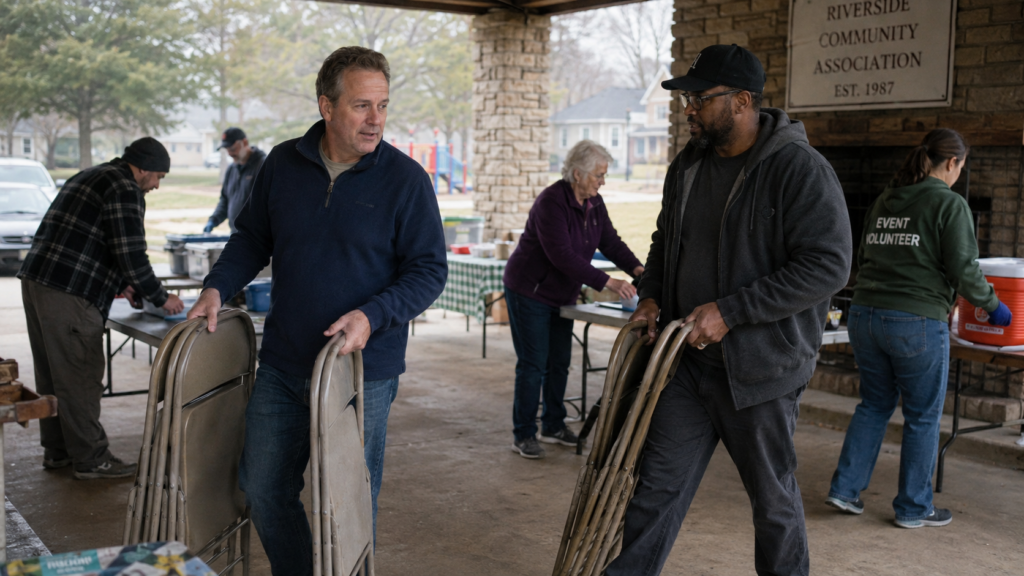
A man does not rebuild community by waiting until he feels social. He rebuilds it by placing himself, repeatedly and responsibly, where real people can come to know him.
Admit When the Circle Has Become Too Small
Men often rename isolation because the honest word feels uncomfortable.
They call it independence, privacy, focus, discipline, or being too busy for nonsense. Sometimes those descriptions are accurate. Some men need more quiet than others. Some are naturally private. Some have learned through painful experience that not everyone deserves access to their life.
Being selective is not the problem.
Selectivity means you choose your people carefully. Isolation means there may be almost no one left to choose.
A few questions can expose the difference:
- Would anyone outside your household notice if you were struggling?
- Do you have anyone to call who is not required by work or family to answer?
- Are most of your conversations about schedules, problems, bills, or tasks?
- Have months passed since you spent time with another man for no practical obligation?
- Do you routinely decline invitations and then resent that no one includes you?
One answer does not define a life. A pattern does.
Men understand maintenance when it applies to roofs, vehicles, tools, software, bank accounts, and heating systems. They know that something can keep working for a while after neglect begins. Then performance drops, small failures multiply, and the repair becomes harder than the maintenance would have been.
Friendship and community work much the same way. They do not require constant attention, but they do require repeated contact.
Admitting that your circle needs repair is not weakness. It is an honest inspection.
Do Not Wait Until Life Is on Fire
One of the worst times to begin building community is the moment you desperately need it.
When a man reaches out only after a divorce, death, job loss, illness, financial collapse, or personal crisis, every interaction carries too much weight. A cup of coffee becomes a rescue attempt. A casual text becomes a flare gun. A person who barely knows him is suddenly being asked to hold years of accumulated loneliness.
That does not mean a man should hide when he is hurting. It means connection works better when some foundation already exists.
Reach out while life is merely narrow, not yet collapsing.
Text the old friend before you need advice. Speak to the neighbor before the storm knocks out power. Join a recurring group before your evenings have become nothing but work, scrolling, and television. Let people see you while you are still capable of participating rather than waiting until you can only ask for help.
This is not manipulation. You are not building relationships so you can cash them in later.
You are maintaining a human life before neglect becomes emergency repair.
Choose Places Built Around Repeated Contact
Adult men often expect friendship to begin with an unusually good conversation. More often, it begins because the same people keep appearing in the same place.
Repeated proximity creates familiarity. Familiarity lowers the social pressure. Lower pressure makes conversation easier. Conversation creates small openings. Some of those openings eventually become trust.
This is why one-time events often disappoint isolated men. A man attends once, feels awkward, talks to almost no one, leaves early, and concludes that the group was not for him.
One appearance rarely gives anyone enough information to know him.
Choose something that repeats:
- A volunteer crew or community workday
- A class, workshop, or makerspace
- A church, recovery, veterans, or service group
- A walking, bowling, shooting, fitness, or martial arts group
- A local board, association, or community garden
- A youth sports program where adults actually help
- A regular breakfast or coffee gathering
- A hobby club built around something you genuinely enjoy
The exact activity matters less than whether it gives people a reason to expect you again.
Do not choose solely by what sounds impressive. Choose something realistic enough that you can return after the first burst of enthusiasm wears off.
Participate Before You Try to Belong
Many isolated men enter a group silently asking, “Will these people accept me?”
That question puts the entire burden on everyone else and turns every quiet moment into evidence of rejection.
A better opening question is, “How can I participate without taking over?”
Help set up chairs. Carry equipment. Take the early shift. Clean up after the visible portion of the event. Bring water. Learn the routine. Ask where help is needed instead of arriving with a plan to reorganize everything.
Many men connect more naturally shoulder to shoulder than face to face. They become comfortable while repairing, coaching, serving, building, lifting, walking, cooking, or solving a practical problem.
There is nothing inferior about that route. Shared work gives conversation somewhere to rest. No one has to stare across a table and manufacture intimacy on demand.
Useful participation also reveals character. People see whether you arrive when you said you would, whether you complain, whether you listen, whether you disappear when cleanup begins, and whether you can contribute without demanding control.
For a fuller treatment of useful contribution and its limits, see Useful Ways to Serve Your Community Without Burning Out.
Reconnect Without Writing a Confession
Some of the easiest community to rebuild may already exist in weakened form.
An old friend. A former coworker. A cousin. A man from a past team, military unit, shop, church, neighborhood, or job. Someone you always respected but lost track of when life became complicated.
Men often delay reconnecting because they believe the first message needs to explain the entire absence.
Usually it does not.
A normal message is enough
“Hey, I was thinking about you today. Hope you’re doing alright.”
Or:
“It has been too long. Want to grab coffee sometime in the next couple of weeks?”
Do not begin with guilt. Do not unload your entire life into the first text. Do not make the other man responsible for repairing your loneliness. Reopen the door and allow him to decide whether he wants to walk through it.
Some men will respond immediately. Some will mean to respond and forget. Some will agree to meet and never settle on a date. Some connections will return for one conversation and fade again.
That is not proof the effort was foolish.
The goal is not to resurrect every relationship from your past. It is to stop assuming that every faded connection is permanently dead.
Stop Requiring Every Man to Match You
Middle-aged men can become highly skilled at disqualifying one another.
One man talks too much. Another votes differently. One is too religious, another not religious enough. One has more money, another less. One is too polished. One eats like a raccoon loose inside a gas station.
Character standards matter. Loneliness is not a reason to ignore dishonesty, cruelty, addiction-driven chaos, manipulation, or reckless behavior. A man should not hand intimate access to anyone who happens to show interest.
But preference can become armor.
Some men reject imperfect connection because finding faults is easier than risking rejection. They claim to be defending standards when they are actually defending distance.
Community does not require agreement on everything. It requires enough shared decency to speak honestly, treat each other respectfully, and work through ordinary difference without turning every disagreement into combat.
Not every connection needs the same depth.
Some men are close friends. Some are project friends, gym friends, church friends, neighbor friends, or men you enjoy seeing twice a month. Some are trustworthy in practical matters but not people you would confide in deeply.
That is not fake friendship. It is a realistic understanding that human relationships have layers.
Build Several Layers Instead of One Perfect Circle
Isolation often causes a man to expect one person or one group to carry too much.
He wants one best friend, one partner, one church, one club, or one online group to meet every social need. That pressure can strain a new connection before it has had time to become anything.
A healthier community usually contains several layers:
- One or two people who know the difficult truth
- A few steady friends who know much of your life
- People connected through work, service, faith, hobbies, or fitness
- Neighbors and familiar local faces
- Men you do not see often but can still contact honestly
No single layer has to do everything.
A modest network changes daily life more than men expect. Familiar people notice when you miss a week. Someone asks how a project turned out. A neighbor knows which vehicle belongs at your house. Another man remembers that your father was sick.
Your life gains witnesses beyond the people who depend on you.
That matters.
Endure the Awkward Stage
The beginning often feels stupid.
You arrive and do not know where to stand. You forget names. A conversation stalls. You wonder whether everyone else already has their people. You feel like the new kid except now your knees hurt and you have a mortgage.
That discomfort is not proof that you chose badly. It is the cost of re-entry.
A group may need time to learn whether you will return. Other people may be cautious. You may be socially rusty after years of communicating mostly through work demands and family logistics.
Give a reasonable place several attempts before making a judgment. Learn names. Ask normal questions. Help with something. Leave before you become exhausted. Return when the group meets again.
Community usually forms more slowly than loneliness wants it to.
There is no shortcut around that.
Do Not Let Social Hunger Ruin Your Judgment
A man who has been isolated for a long time can become hungry enough to grab at the first sign of welcome.
He may overshare, overtext, overcommit, volunteer for everything, mistake friendliness for deep loyalty, or reshape himself to fit the first group that makes room for him.
That can drive healthy people away. It can also draw him toward unhealthy people.
Manipulative movements, predatory business schemes, extremist communities, cultish organizations, and toxic online groups understand the power of belonging. They welcome the isolated man intensely, tell him his frustration proves he sees the truth, and gradually demand loyalty, money, obedience, anger, or separation from anyone who questions the group.
Healthy community does not require instant surrender.
Be cautious when a group:
- Demands immediate loyalty
- Feeds resentment as its main source of unity
- Claims everyone outside the group is corrupt or blind
- Punishes ordinary questions
- Pressures members to abandon other relationships
- Turns one leader into an unquestionable authority
Real community gives a man roots. Counterfeit community puts him on a leash.
Do Not Build Belonging Around Complaint
Men often break the ice through complaint.
Work is foolish. Prices are high. Politicians are corrupt. The neighborhood has changed. Younger people are soft. Older people are stubborn. Everything was better before someone moved the date of “before” to wherever his memory became selective.
Shared frustration can begin a conversation. It cannot sustain a healthy community.
A group held together by resentment eventually needs more resentment to remain close. It searches for enemies, rewards exaggeration, and makes bitterness feel like brotherhood.
Build connection around something more durable:
- Service
- Skill
- Family
- Faith
- Recovery
- Fitness
- Craft
- Mentorship
- Shared meals
- Local improvement
- Honest conversation
- Work worth doing
Complaint may open the door. It should not become the house everyone lives in.
Accept That You May Need to Move First
Some men wait for community to come find them.
They want someone else to invite, organize, call, notice, include, and follow up. That desire is understandable, especially after years of feeling overlooked. It also keeps a man passive.
At some point, someone has to make the first ordinary move.
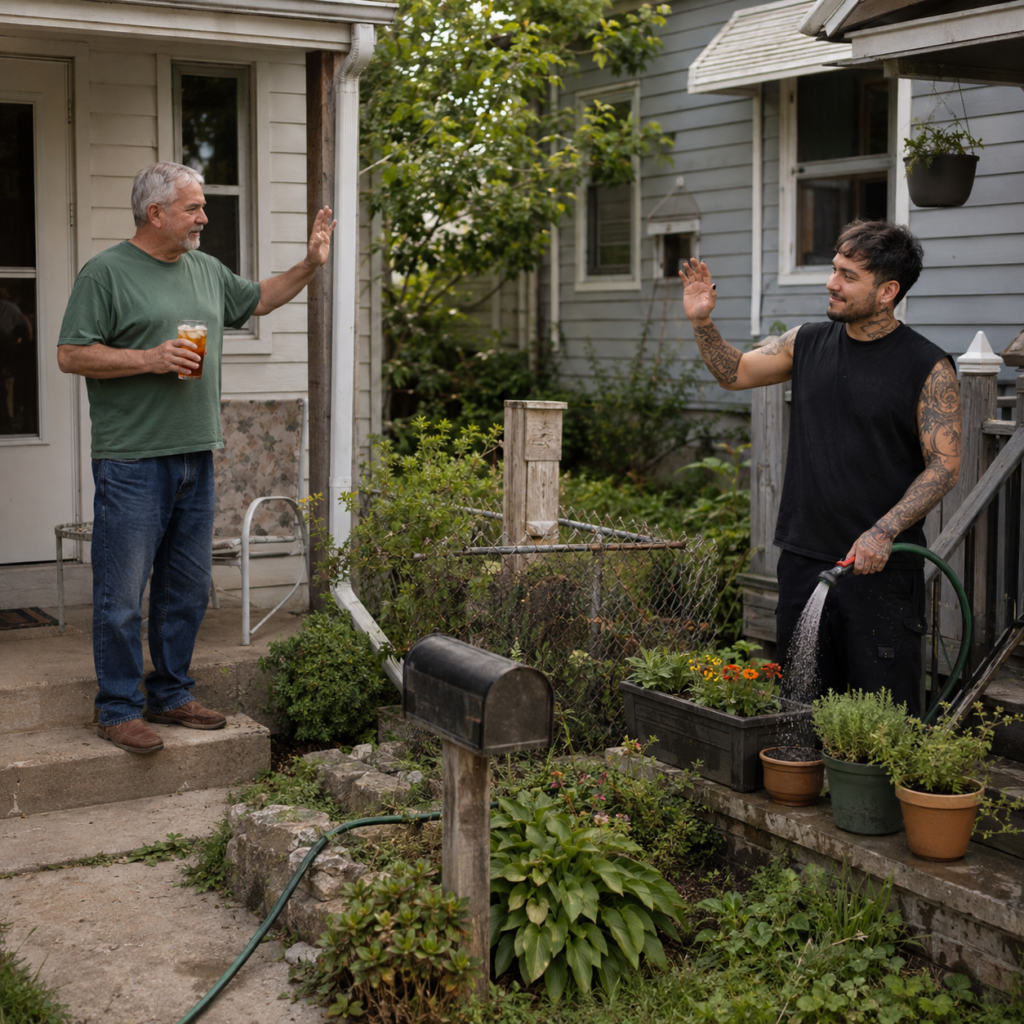
Send the text. Introduce yourself. Invite another man for coffee. Ask the neighbor whether he needs help before the storm. Volunteer for one task. Suggest a walk. Speak to another father at practice instead of staring at your phone.
This is not chasing people or begging for attention. It is accepting that adult community often belongs to the people willing to risk a modest invitation.
The invitation may fail. The man may be busy. The conversation may go nowhere.
That is survivable.
Start Smaller Than Your Pride Wants
You do not need to launch a men’s group, organize a neighborhood festival, join three committees, or explain your loneliness to a room full of strangers.
Start with actions small enough to repeat:
- Learn one neighbor’s name.
- Send one message to someone you have lost touch with.
- Choose one recurring place and attend more than once.
- Volunteer for one task with a clear beginning and end.
- Stay ten minutes after an event instead of leaving immediately.
- Ask one man a normal question and listen to the answer.
- Return when you said you would.
These steps may seem too small because isolation makes men crave a dramatic cure.
There usually is no dramatic cure.
There is repeated contact. There is decent behavior. There is patience with awkward beginnings. There is judgment about who deserves deeper trust. There is the willingness to contribute before demanding belonging.
A man who has drifted into isolation does not need to transform into an extrovert or become someone else.
He needs to stop disappearing by habit.
That work can begin with one place, one person, and one ordinary return.