
Most men agree that community matters. Fewer know what that is supposed to look like at the mailbox, across a fence, or when the dog next door has been barking since midnight.
That is where the principle becomes real.
Being a good neighbor does not require becoming the mayor of the cul-de-sac. You do not need to organize block parties, borrow tools from everyone, or stand in the driveway collecting neighborhood intelligence. You do not have to force friendships with people simply because their mortgage happens to be near yours.
You do have to recognize that your life does not stop cleanly at the property line.
The condition of your home affects other people. Your noise affects them. Your animals, vehicles, trees, guests, children, trash, temper, and willingness to communicate all extend beyond your front door. Their lives reach into yours in much the same way.
Tenet 6: Community Matters asks a man to accept that responsibility without becoming intrusive, controlling, or desperate to be needed.
The standard is not popularity. It is whether the people living near you are slightly better off because you are there.
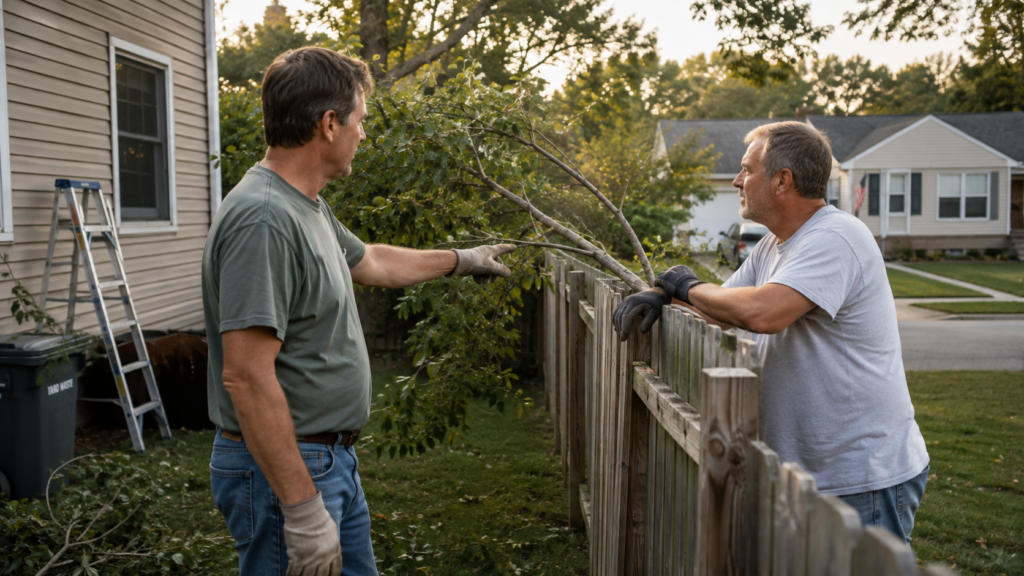
A good neighbor is known, useful, responsible, and appropriately restrained. He does not disappear from the people around him, and he does not appoint himself to run their lives.
Start by Becoming Recognizable
The first level of community is not friendship. It is recognition.
The people closest to you should know roughly who you are, which house is yours, and that you are safe to approach when something ordinary needs to be said. That can begin with a wave, a nod, a brief conversation at the mailbox, or a normal introduction when someone moves in.
Learn a few names. Start with the people beside you and across from you. You do not need their biography, voting history, medical record, or opinion on every subject. You are simply acknowledging that they are people rather than scenery surrounding your property.
This is harder for some men than it sounds. A man can spend years pulling into the garage, lowering the door, and retreating into the house before he realizes he has turned privacy into isolation.
There is nothing wrong with being private. There is something unhealthy about living among people for a decade while making no effort to become known as a decent human being.
Men who have become deeply disconnected may need to rebuild this skill more deliberately. That broader process is covered in How Men Build Community When They Feel Isolated. At the neighborhood level, the first move remains small: look up, say hello, and learn one name.
Friendly Does Not Mean Intrusive
Some men avoid their neighbors because they fear that one conversation will lead to endless interruptions, borrowed equipment that never returns, personal drama, or an invitation to join a committee that apparently meets every Thursday until death.
That concern is not entirely imaginary. Some people have poor boundaries. That does not justify treating everyone as a threat.
Good neighborliness should be low pressure. Greet people. Talk when it feels natural. Offer help when the need is obvious. Let the other person end the conversation without making him work for his escape.
Do not ask personal questions simply because you are curious. Do not comment on someone’s marriage, income, visitors, parenting, lawn, work schedule, religion, or politics unless that conversation has been invited. Do not watch the street as though you have been appointed director of neighborhood intelligence.
Some neighbors are shy. Some are exhausted. Some work odd hours. Some have had enough experience with intrusive people to be cautious. Some simply prefer more distance than you do.
A steady man does not force connection. He behaves in a way that makes connection possible.
The practical balance
Be present
- Learn names
- Acknowledge people
- Notice obvious needs
- Communicate early
Respect distance
- Do not pry
- Do not force friendship
- Do not spread gossip
- Do not manage other adults
Keep Your Own Disorder From Becoming Everyone Else’s Problem
One of the most useful things a man can do for his neighborhood is take reasonable care of what belongs to him.
This is not an argument for manic suburban perfection. No one needs to shape every shrub into a geometric object or panic because a dandelion has crossed the perimeter. A neighborhood is a place where people live, not a showroom arranged for resale photographs.
Basic stewardship still matters.
Control your animals. Deal with your trash. Keep music and machinery reasonable. Park with some awareness that other people use the road. Do not let guests block driveways. Maintain shared edges. Keep dangerous limbs, broken fencing, runoff, and unfinished projects from spilling indefinitely onto someone else’s property.
Return what you borrow. Replace what you damage. If your child breaks something, deal with it instead of disappearing behind the fiction that children are never anyone’s responsibility. If you create a problem, acknowledge it before someone has to hunt you down.
A man who talks about community while exporting disorder to everyone around him is not community-minded. He is demanding tolerance.
The point is not appearances. It is respect.
Handle Small Problems While They Are Still Small
Neighborhood wars rarely begin with something worthy of war. They begin with barking dogs, blocked driveways, overhanging branches, loose trash, late music, property lines, children, parking, or a fence that leaned six inches farther last winter.
The original problem is usually manageable. The resentment built around it is not.
Men often make this worse in one of two ways. Some avoid the conversation until they are furious. Others arrive furious because they have spent three weeks rehearsing the prosecution in their head.
The better approach is early, calm, and direct.
“I’m not sure you can hear it from inside, but the dog has been barking pretty late the last few nights” gives a neighbor useful information and a chance to respond.
“Your dog never shuts up and everyone is sick of you” may express the depth of your irritation, but it leaves very little room for the other person to correct the problem without first defending himself.
That distinction matters. A lot of men are factually right and socially foolish at the same time. They win the sentence and damage a relationship with someone they may live beside for another fifteen years.
Give the other person a reasonable path to fix it
Describe the issue rather than assigning a character defect. Be specific. Speak directly to the person involved instead of gathering allies first. Do not threaten consequences before you have made a normal request.
Then listen.
You may learn that the neighbor did not know. You may learn that he is already working on it. You may learn that your understanding is incomplete. You may also learn that he has no intention of changing anything.
Calm communication does not guarantee cooperation. It does ensure that you did not create a larger conflict before you understood the smaller one.
Be Useful in Small, Boring Ways
Community is built less by heroic gestures than by repeated acts of ordinary usefulness.
Bring in a trash can that has blown into the road. Tell someone his garage door is open before a storm. Help push a stuck vehicle when it is safe. Pick up a package left in the rain. Check on an older neighbor after a power outage. Keep an eye on a house when someone is traveling. Return a loose dog without acting as though you completed a wilderness rescue.
These things matter because they create evidence. They show that the people nearby are not entirely on their own.
The work should remain proportionate. You are not required to become the neighborhood handyman, emergency dispatcher, counselor, chauffeur, and unpaid property manager. A healthy community is not one useful man carrying everyone else.
It is many people doing modest things when they can.
For a broader discussion of choosing useful service without turning it into exhaustion or resentment, read Useful Ways to Serve Your Community Without Burning Out.
Know When to Stay Out of It
Being a good neighbor includes knowing what does not belong to you.
Not every argument next door is your business. Not every parenting choice requires commentary. Not every political sign requires a response. Not every untidy yard is a threat to civilization. Not every rumor needs another pair of legs.
Men sometimes confuse concern with authority. Once they become involved in the neighborhood, they begin acting as though involvement grants them jurisdiction over everyone in it.
It does not.
There are situations where action is justified. Immediate danger, suspected abuse, fire, violence, serious threats, and criminal conduct are not merely private eccentricities. Use judgment, protect people where you reasonably can, and involve the proper authorities when a situation exceeds what can be handled safely.
Most ordinary irritation does not rise to that level.
Start with patience. Use direct communication when needed. Set a boundary when necessary. Escalate only when the actual problem justifies it.
A steady man knows the difference between being present and being in the way.
Do Not Turn Helpfulness Into a Claim on Other People
There is a quiet form of control that often hides inside generosity.
A man helps someone move a couch, clears snow from a sidewalk, repairs a gate, or watches a house for a week. Then he begins carrying an invisible ledger. He expects loyalty, agreement, praise, access, or future labor in return.
That is not generosity. It is an unstated contract the other person never agreed to.
Help because the help is reasonable and you freely decided to give it. Do not turn basic decency into leverage. Do not repeatedly mention what you have done. Do not use service to purchase authority over people who did not ask to be managed.
The same principle applies when sharing experience with younger neighbors. Advice becomes useful only when it respects the other man’s dignity and ability to decide. How to Mentor Younger Men Without Preaching at Them develops that distinction more fully.
Say Yes Sometimes, Not Automatically
A man who never helps anyone becomes isolated. A man who agrees to everything becomes exhausted and resentful.
The useful middle is not complicated. Say yes when the request is reasonable, you have the capacity, and helping will not cause you to neglect more important responsibilities. Say no when you cannot help without resentment, damage, risk, or repeated misuse.
You do not need a courtroom argument to decline.
“I can’t help with that this time” is a complete sentence.
Boundaries do not weaken a neighborhood. They keep contribution from becoming dependency and kindness from becoming bitterness.
What Better Neighboring Looks Like
It usually looks unimpressive.
It looks like checking on the older man across the street when his newspaper has not moved. It looks like telling the young father next door that his garage door is open before heavy rain arrives. It looks like giving a teenager some grace after a foolish parking mistake, then speaking to him without trying to humiliate him.
It looks like keeping your temper when someone else is careless. It looks like apologizing when the careless person was you. It looks like taking care of your property without becoming self-righteous about someone else’s. It looks like offering help without announcing your virtue.
Sometimes it looks like leaving people alone.
That balance is the whole practice:
- Present without being intrusive
- Helpful without needing to be needed
- Responsible without becoming controlling
- Friendly without demanding friendship
- Private without becoming invisible
The Goal Is Not Popularity
Some neighbors will not respond to you. Some will remain difficult. Some will interpret friendliness as weakness, boundaries as hostility, or help as an invitation to ask for more.
You cannot control that.
The goal is not to become universally liked. The goal is to become a man whose presence adds steadiness rather than friction to the place where he lives.
Character should have a radius. It should serve your household first, but it should not die at the mailbox.
A better neighborhood does not require everyone to agree, socialize, vote alike, worship alike, or live alike. It begins when enough people decide to become more responsible for what belongs to them, more useful when reasonable needs arise, and less eager to treat every irritation as an enemy action.
None of that is grand. It will not make a man important.
It may make the street safer, calmer, and a little more human.
That is enough reason to walk outside, look around, and stop treating the people nearest to you as strangers by default.