
Most younger men do not need another lecture.
They have already been lectured by parents, teachers, supervisors, coaches, politicians, influencers, advertisers, and older men who believe every conversation improves when it becomes a speech about how things used to be.
That does not mean younger men do not need guidance.
Many do. They need examples of steadiness, judgment, responsibility, restraint, honest work, decent relationships, financial discipline, and what to do after making a mess of something.
But guidance only becomes mentorship when experience is offered as service rather than authority.
A mentor is not simply an older man with opinions. Every older man has opinions. Some are earned wisdom. Some are old injuries wearing a respectable coat.
The work is learning the difference.
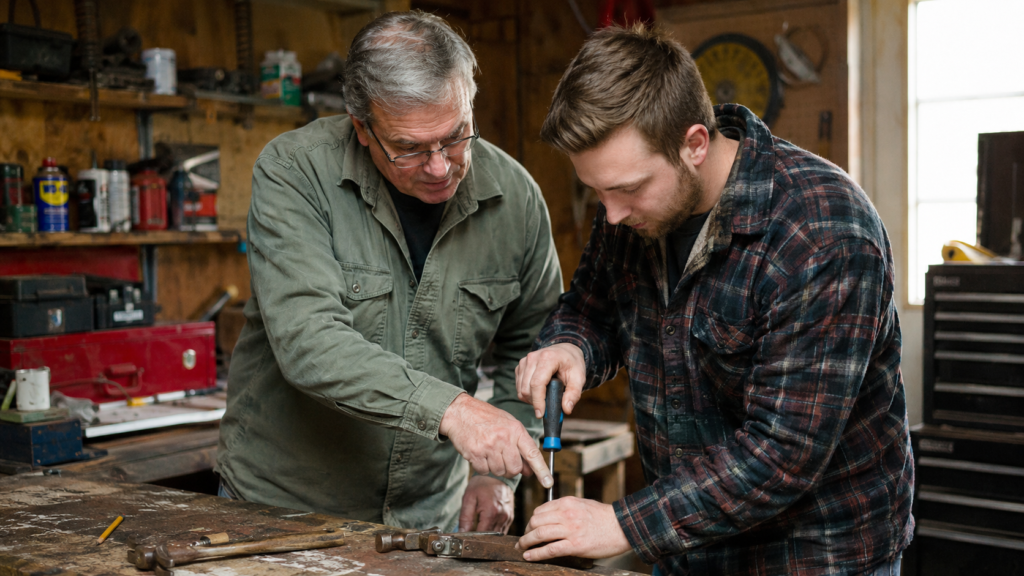
Good mentorship does not make a younger man dependent on your judgment. It helps him develop judgment of his own.
Earn the Right to Be Heard
Older men often want influence before they have earned trust.
They see a younger man spending recklessly, showing up late, treating people badly, drifting through work, avoiding responsibility, or making a decision whose consequences are obvious from twenty years away.
The instinct is to correct him immediately.
Sometimes that is necessary. If safety, dishonesty, abuse, or serious damage is involved, a man should not hide behind politeness.
Most of the time, however, trust comes before influence.
A younger man is more likely to hear advice from someone he has already watched handle pressure, keep his word, treat people fairly, admit mistakes, work without constant complaint, and carry responsibility without demanding applause.
You do not need a flawless life. Flawless men do not exist, and men pretending to be flawless are poor teachers.
Your life simply needs enough consistency that your words are not unsupported.
If you preach discipline while your own life is chaos, he will notice. If you preach respect while speaking to everyone with contempt, he will notice. If you preach accountability while blaming every failure on someone else, he will notice that too.
Mentorship begins with the part of your life he can see.
Be an Example Before Becoming an Instructor
Younger men watch more than they admit.
They notice how older men speak about their wives, children, former partners, customers, bosses, coworkers, enemies, and people who cannot do anything for them.
They notice whether a man cuts corners when no one is watching. They notice whether he changes personalities around powerful people. They notice whether he stays steady when embarrassed or becomes cruel when challenged.
This is why example usually carries more weight than explanation.
A younger man may ignore what you say and still absorb how you live.
If your pattern is quiet competence, he may learn that strength does not need constant announcement. If your pattern is bitterness, he may learn that manhood means being angry about everything and responsible for nothing.
Older men teach even when they are not trying.
The question is whether what you are showing is worth learning.
Do Not Turn Every Conversation Into a Lesson
Few things make a younger man stop talking faster than realizing every conversation with you ends in a moral.
Sometimes he needs help changing brakes, finishing a project, dealing with a customer, working through a budget, preparing for an interview, cooking a decent meal, or learning how to complete a task correctly.
Not every moment requires a speech about character.
Ordinary time together is often where trust develops. A lesson may appear naturally, but it does not have to be announced like a training module.
A good mentor knows when to speak and when to let a normal conversation remain normal.
That does not mean avoiding hard subjects. It means not forcing every subject into your preferred lecture.
If he is treating someone badly, wasting money he cannot afford to lose, repeatedly arriving late, lying, or refusing responsibility, say something.
But say what the situation requires, not everything you have ever learned.
Preaching Versus Mentoring
| Preaching | Mentoring |
|---|---|
| Starts with the older man’s opinion | Starts with the younger man’s actual situation |
| Uses general criticism | Names specific behavior and consequences |
| Tries to prove authority | Builds credibility through conduct |
| Creates dependence or obedience | Develops judgment and capability |
| Turns every opening into a speech | Uses timing, questions, work, and example |
| Treats disagreement as disrespect | Allows the younger man to think and choose |
Ask Questions That Require Thought
“What were you thinking?” is rarely a real question. It is usually an accusation with punctuation.
Better questions make a younger man examine what happened without immediately forcing him into defense.
- What did you expect to happen?
- Where did it begin going wrong?
- Who is paying the price for this decision?
- What are you trying to prove?
- What would you do differently next time?
- What happens if you keep doing it this way?
Those questions do not guarantee honesty or insight. Nothing does.
They do, however, make room for judgment to develop.
Many younger men already know they are making a mess of something. They may not need twenty minutes explaining that they failed. They may need one direct observation, one useful question, and help identifying the next responsible move.
The goal is not to win the exchange.
The goal is to help him think better when you are no longer standing there.
Tell the Truth Without Humiliating Him
Mentorship does not require endless gentleness.
Some younger men need to hear that they are being lazy, dishonest, careless, arrogant, selfish, reckless, or unreliable.
But correction becomes useless when the older man enjoys the power of being right more than he cares about the result.
Useful correction is specific.
“You were late three times this week. People cannot trust you to do the job if you keep doing that. Fix it.”
That gives him something to confront.
“Your whole generation has no work ethic” gives him nothing except evidence that you enjoy complaining.
Name the behavior. Explain the consequence. Make the standard clear. Leave room for repair.
Do not turn a correctable failure into a permanent identity.
A man can be acting weakly without being permanently weak. He can be irresponsible without being beyond responsibility. He can fail badly without becoming a failed human being.
Correction should create a path forward, not merely establish who is superior.
Do Not Make Him Carry Your Regrets
Older men often see their own past mistakes in younger men.
The bad relationship. The years of drinking. The debt. The missed opportunity. The job they stayed in too long. The job they quit too early. The time they neglected their health, family, or character.
Those regrets can become useful experience.
They can also become a burden placed on someone who did not live your life.
A younger man is not your second chance. He is not responsible for proving that your pain meant something. He does not have to build the exact life you wish you had built.
Share your mistakes when they illuminate his situation.
There is power in an older man saying, “I handled something similar badly, and it cost me.”
There is much less value in demanding that he organize his entire life around your unresolved fear.
The purpose is to help him build his life, not force him to reenact yours with improved decisions.
Teach Through Useful Work
Many character lessons land better when attached to practical work.
Budgeting teaches restraint. Tool work teaches patience. Cooking teaches self-reliance. Exercise teaches consistency. Vehicle maintenance teaches attention. Showing up when promised teaches respect. Cleaning after a project teaches responsibility.
You do not always need to announce the lesson.
Sometimes good mentorship sounds like:
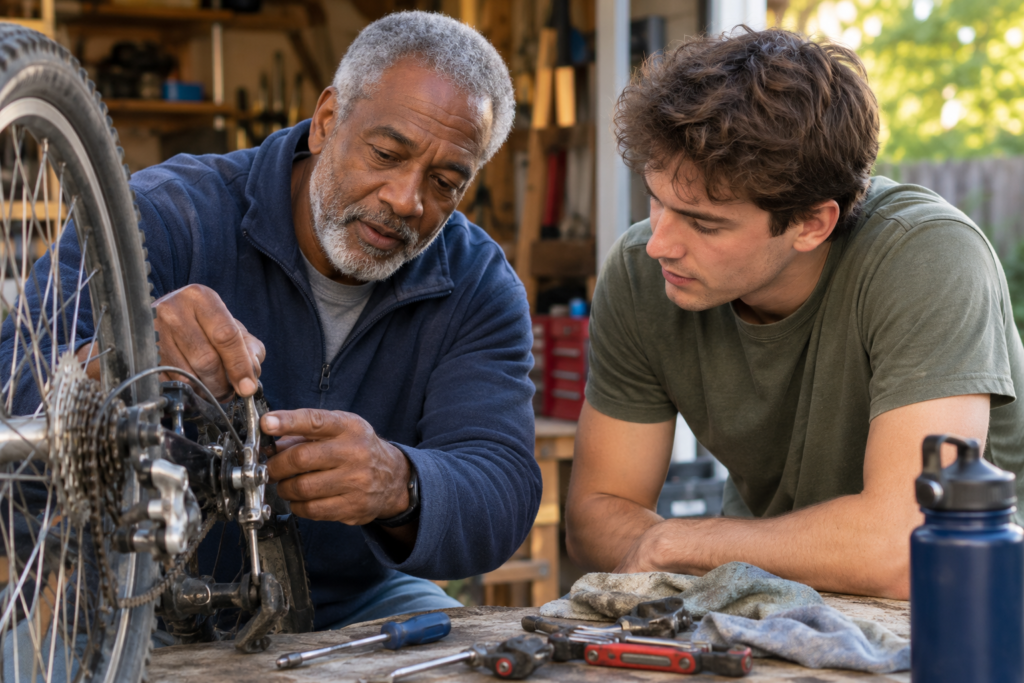
- “Come by Saturday and I will show you how to fix it.”
- “Bring your bills and pay stubs. Let us see where the money is going.”
- “You can help with this project, but if you say eight o’clock, be here at eight.”
- “Try it yourself first. I will stop you before you damage anything.”
Practical work gives a younger man somewhere to grow without making every encounter feel like emotional analysis.
Many men speak more honestly when their hands are occupied and their eyes are not fixed across a table.
That is not avoidance. It is often simply how trust develops.
Help Without Removing Every Consequence
If you care about a younger man, you may want to rescue him from every bad outcome.
You may want to pay the bill, call the employer, smooth over the conflict, excuse the absence, fix the relationship, or step between him and the result of his own decision.
Sometimes intervention is appropriate. A man in serious danger may need immediate help. A small mistake can become life-altering if no one steps in.
But repeated rescue can keep a man weak.
Support does not always mean removing the consequence. It may mean standing nearby while he faces it.
You can help him plan the repair. You can help him make the call. You can remind him that failure is survivable. You can refuse to let one mistake become an excuse for five more.
What you should avoid is repeatedly paying the price that belongs to him.
Mentorship is not carrying another man indefinitely.
It is helping him become capable of carrying himself.
Respect the Limits of the Relationship
If the younger man is not your son, do not behave as though you are automatically his father.
You may be an uncle, supervisor, coach, neighbor, tradesman, sponsor, older friend, or trusted man in the community.
Those roles matter. They can change the direction of a life.
They still have boundaries.
You are not entitled to obedience, private information, constant access, or control over every decision.
You can offer perspective. You can establish standards when he works with you. You can refuse dishonesty or disrespect. You can ask difficult questions. You can withdraw support from behavior you will not enable.
But do not confuse influence with ownership.
This matters especially when a younger man lacks a stable father figure. His need may be real, and your influence may become significant. That does not give you permission to make yourself the center of his development.
A good mentor develops independence.
He does not manufacture dependence and call it loyalty.
Model Repair, Not Perfection
One of the most valuable things an older man can demonstrate is what to do after being wrong.
Many younger men have seen only two models.
Some men deny everything, blame everyone else, and treat apology as surrender. Other men collapse into shame, punish themselves theatrically, and still fail to repair the damage.
Mature repair is simpler.
“I did that. It was wrong. Here is what I am doing to correct it.”
If you gave bad advice, admit it. If you spoke too harshly, correct it. If you failed to keep a promise, make it right. If you misunderstood the situation, say so.
No performance. No excuses. No demand that the younger man comfort you for feeling guilty.
An older man who can repair his own mistakes teaches more about strength than one who never admits having made any.
Know When the Problem Is Outside Your Lane
Mentorship matters, but it is not a replacement for every form of help.
A younger man may need medical care, legal counsel, addiction treatment, financial expertise, mental health support, emergency intervention, or protection from an unsafe situation.
Personal experience does not qualify an older man to handle every crisis.
There is no failure in saying, “I care about you, but this is beyond what I know how to handle.”
Knowing your limits protects both men.
It also models something younger men need to see: a capable man can admit when expertise, authority, or additional help is required.
Mentorship Usually Starts Small
You do not need to create a program or announce yourself as anyone’s mentor.
Mentorship often begins in ordinary places.
A supervisor takes five extra minutes to explain how to handle a customer. An older neighbor teaches a teenager to use a mower safely. An uncle helps a nephew build a budget. A tradesman lets a junior worker try the task instead of taking the tool away. A man notices a young father struggling and invites him to talk.
These small moments are part of what Tenet 6: Community Matters asks of men.
Community is not only helping strangers or attending public events. It includes passing useful knowledge forward and taking some responsibility for the men coming behind you.
That responsibility does not require control.
It requires availability, honesty, patience, boundaries, and a willingness to let experience become useful to someone besides yourself.
A man who wants to contribute locally can also learn how to be a better neighbor without becoming intrusive and how to serve his community without burning himself out.
The Goal Is Strength, Not Control
The purpose of mentoring a younger man is not to make him obey you.
It is not to prove that your generation was better, build an audience for your stories, create a follower, or make yourself feel indispensable.
The purpose is to help him become steadier, more responsible, more capable, and better able to make decisions when no older man is present.
That means he may eventually disagree with you.
He may take what was useful and build a life different from yours. He may surpass you in areas where you once guided him. He may stop needing advice as often.
That is not a loss of influence.
That is the point.
Good mentorship produces a man who can stand without leaning on his mentor forever.
You are not the hero of his story. You are one influence, hopefully a useful one.
Take that role seriously without making it larger than it is.
Younger men do not need perfect older men.
They need real ones who have learned something, survived some things, corrected some things, and are willing to pass forward what is useful without making the whole room listen to a speech.
That is mentorship at its best.
Not control. Not performance. Not nostalgia.
One man helping another become more capable of carrying his own life.