
There are questions a man can answer by working harder, reading better information, or admitting that he was wrong.
There are other questions that do not surrender so easily.
Why are we here? Does suffering have meaning? Is there anything beyond death? Is there a God, and what would that require of us? Are morality and human dignity grounded in something larger than agreement? Why do beauty, love, sacrifice, and grief feel larger than the mechanical facts that accompany them?
A man may live with these questions for decades. Age does not guarantee an answer. Loss does not automatically produce wisdom. Religious participation does not eliminate doubt, and disbelief does not eliminate wonder.
Honesty may leave a man with fewer declarations than he once had.
That does not leave him with nothing.
Tenet 3: Spiritual Without the Chains does not require certainty. It requires a man to stop pretending, continue examining, and live responsibly while some of the largest questions remain unanswered.
Certainty and Commitment Are Not the Same Thing
Men often assume that commitment must wait until uncertainty disappears. We tell ourselves that we cannot choose a direction until every concern has been resolved and every alternative has been eliminated.
Life does not usually give us that luxury.
A man marries without knowing everything the marriage will face. He raises children without proof that every decision is correct. He accepts responsibility for aging parents without knowing how long the responsibility will last. He chooses work, friendship, service, and sacrifice without receiving guarantees.
Commitment is not a claim that uncertainty has disappeared. It is a decision about how you will live in its presence.
A Mature Spiritual Life
You do not need complete certainty to live with honesty, compassion, courage, gratitude, restraint, and responsibility. You need enough humility to admit what you do not know and enough conviction to stop using uncertainty as an excuse.
Doubt Is Not a Moral Failure
Some men were taught that doubt reveals weakness, disloyalty, or a defective character. They learned to fear the question before they had even considered the answer.
That fear can produce outward conformity without inward trust. A man learns which words preserve peace, which questions are dangerous, and which parts of himself must remain hidden. He may continue performing certainty because the social cost of honesty feels too high.
Other men make the opposite mistake. They treat doubt as proof of sophistication. Every conviction becomes suspect, every tradition becomes manipulation, and every person who believes strongly becomes naive.
Both positions use doubt poorly.
Doubt is a condition to examine, not an identity to worship or a defect to conceal. It can reveal weak reasoning, unresolved pain, hypocrisy, missing evidence, or the limits of human understanding. It can also become a convenient way to avoid choosing anything.
The question is not whether doubt exists. The question is what a man does with it.
Uncertainty Is Not Indifference
“I do not know” can be one of the most honest sentences a man speaks.
It can also become a shield.
A man may say he does not know what he believes when what he means is that he does not want any belief to place a demand on him. He avoids moral commitments because every principle has exceptions. He avoids spiritual practice because he cannot prove what it accomplishes. He avoids responsibility because certainty is unavailable.
That is not humility. It is indefinite postponement.
Three positions that sound similar but are not
Uncertainty: I do not have a complete answer, but I will continue examining the question and living according to the strongest principles I can honestly defend.
Indecision: I keep revisiting the question because I am afraid of choosing imperfectly or accepting the cost of a decision.
Indifference: I claim the question cannot be answered because I do not want it to affect how I live.
Uncertainty remains engaged. Indecision circles. Indifference walks away.
The False Comfort of Pretending
Certainty can provide structure, community, and peace. It can also be performed.
A man may repeat language he no longer believes because his marriage, family, employment, friendships, or community seem to depend on it. He may continue participating in a tradition while becoming increasingly divided inside.
There are situations where discretion matters. A man does not owe every private question to every person who demands an answer. He may need time, safety, or trusted company before speaking openly.
But there is a difference between privacy and a life built on permanent spiritual performance.
Pretended certainty creates a quiet fracture. The public man and private man begin living separate lives. He may become resentful toward the people whose acceptance he fears losing, even when they do not know the full truth. He may become angry at himself for continuing the performance and angry at anyone who asks him to stop.
Honesty does not require reckless disclosure. It does require that a man stop lying to himself.
How to Live While the Questions Remain Open
A spiritual life without certainty needs more than vague openness. It needs practices and standards strong enough to keep uncertainty from becoming drift.
Hold provisional convictions
A provisional conviction is not a disposable opinion. It is the position you currently judge to be most honest and responsible, held with enough humility to allow new understanding.
You may believe human beings possess inherent dignity without claiming to understand the ultimate source of that dignity. You may believe love and service matter even while questions about God remain unresolved. You may participate in a tradition because its practices deepen your life while remaining uncertain about some of its doctrines.
A provisional conviction lets a man stand somewhere without pretending the ground is beyond examination.
Separate the question from the performance
Ask what you genuinely want to understand and what you merely want to be seen believing. The answer may be uncomfortable. Men are capable of using both religion and disbelief as social clothing.
Finding meaning without borrowing someone else’s beliefs requires examining whether your stated position comes from honest conviction, fear of rejection, resentment toward the past, or loyalty to a new tribe.
Continue useful practices
A man does not need a complete theory of prayer before sitting quietly with gratitude, grief, or hope. He does not need metaphysical certainty before walking in nature, serving another person, reading serious work, attending a meaningful ceremony, or reflecting on how he is using his life.
Practice should not be used to manufacture feelings or force an answer. It creates room for attention.
Choose moral commitments
Uncertainty about ultimate questions does not make cruelty, dishonesty, cowardice, or neglect morally neutral. A man can continue choosing truth, responsibility, compassion, restraint, and repair without claiming to possess a final explanation for existence.
You may not know everything that makes a life good. You can still recognize many of the ways a life becomes smaller.
Keep company with men who can tolerate honesty
Some communities demand certainty as the price of belonging. Others demand disbelief with equal rigidity. Both make honest examination difficult.
Look for people who can discuss belief without recruiting, mocking, panicking, or turning every question into a contest. A mature conversation leaves room for conviction, doubt, experience, disagreement, and silence.
Questions Change as a Man Ages
The questions a man asks at twenty may be mostly intellectual. At forty, they may become tied to work, marriage, fatherhood, disappointment, and the gap between the life he expected and the life he has.
Later, the questions become less theoretical.
What have I done with the years I received? Who became stronger because I was here? What did ambition cost? What do I owe the people I failed? What can still be repaired? What will remain after I am no longer able to control the outcome?
Aging does not always deliver certainty. It does remove some of the distractions that allowed a man to postpone the questions.
That can be frightening. It can also be clarifying.
Grief Does Not Follow a Spiritual Script
Loss often exposes the difference between beliefs a man can repeat and beliefs he can actually inhabit.
A grieving man may feel comfort, anger, numbness, gratitude, doubt, resentment, love, and confusion in the same week. He may return to a faith he thought he had left. He may question a faith he thought was settled. He may discover that explanations feel offensive when what he needs is presence.
Spiritual maturity does not require a man to turn grief into a lesson before he has lived through it.
He can let the loss remain painful. He can allow questions that have no immediate answer. He can accept help without agreeing with every explanation offered to him.
Uncertainty during grief is not betrayal. It is often part of confronting what the loss actually means.
When Questioning Becomes Avoidance
There is no deadline by which a man must solve his spiritual life. There is also no virtue in endlessly reopening every conclusion so that nothing can ever require action.
Questioning has become avoidance when:
- You use complexity to excuse conduct you already know is harmful.
- You refuse every commitment because a better answer might appear later.
- You consume endless arguments but never practice reflection.
- You demand proof from every belief except the assumptions that protect your comfort.
- You treat uncertainty as evidence that nothing deserves loyalty.
- You keep asking the same question because you dislike the cost of the most honest answer.
A question should deepen your attention. If it only helps you remain untouched, it is no longer doing honest work.
You Are Allowed to Stand Without Claiming Final Ground
A man can say, “This is what I currently believe,” without adding, “and no honest person could disagree.”
He can remain part of a tradition while admitting unresolved questions. He can leave a tradition without treating everyone who remains as weak. He can live outside religion without reducing wonder, reverence, or moral obligation to stupidity.
He can carry uncertainty without allowing it to hollow out his life.
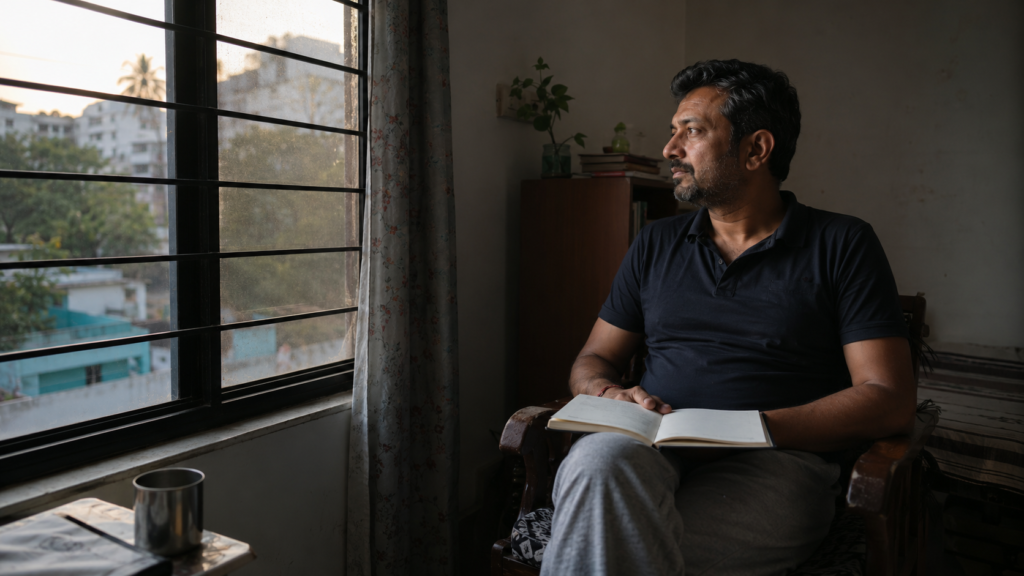
Solitude and reflection can give those questions room without forcing them into premature answers. The point is not to reach a dramatic conclusion every time. The point is to become more honest about the life you are already living.
Certainty may come. It may change. It may remain incomplete.
Your responsibility to live deliberately remains.