
Most men will say their family comes first.
The harder question is whether the people living with them would describe it that way.
Family first is not proven by affection, intention, income, or the number of sacrifices a man can list. It is proven through the pattern his family experiences: whether he is present, dependable, honest, protective without becoming controlling, and willing to carry responsibilities that cannot be solved with money.
This Tenet is not about building a perfect household. There is no such thing. Families are made of tired, stubborn, frightened, hopeful, imperfect people who know exactly where one another is weakest. Good principles become harder to practice at home because home is where performance eventually runs out.
That is also why family life matters so much. It is one of the clearest places a man learns whether his values can survive inconvenience, repetition, disagreement, and ordinary responsibility.
What Family First Actually Means
Family first means treating the health of the household as a primary responsibility rather than something that receives whatever time, patience, and attention remain after everything else.
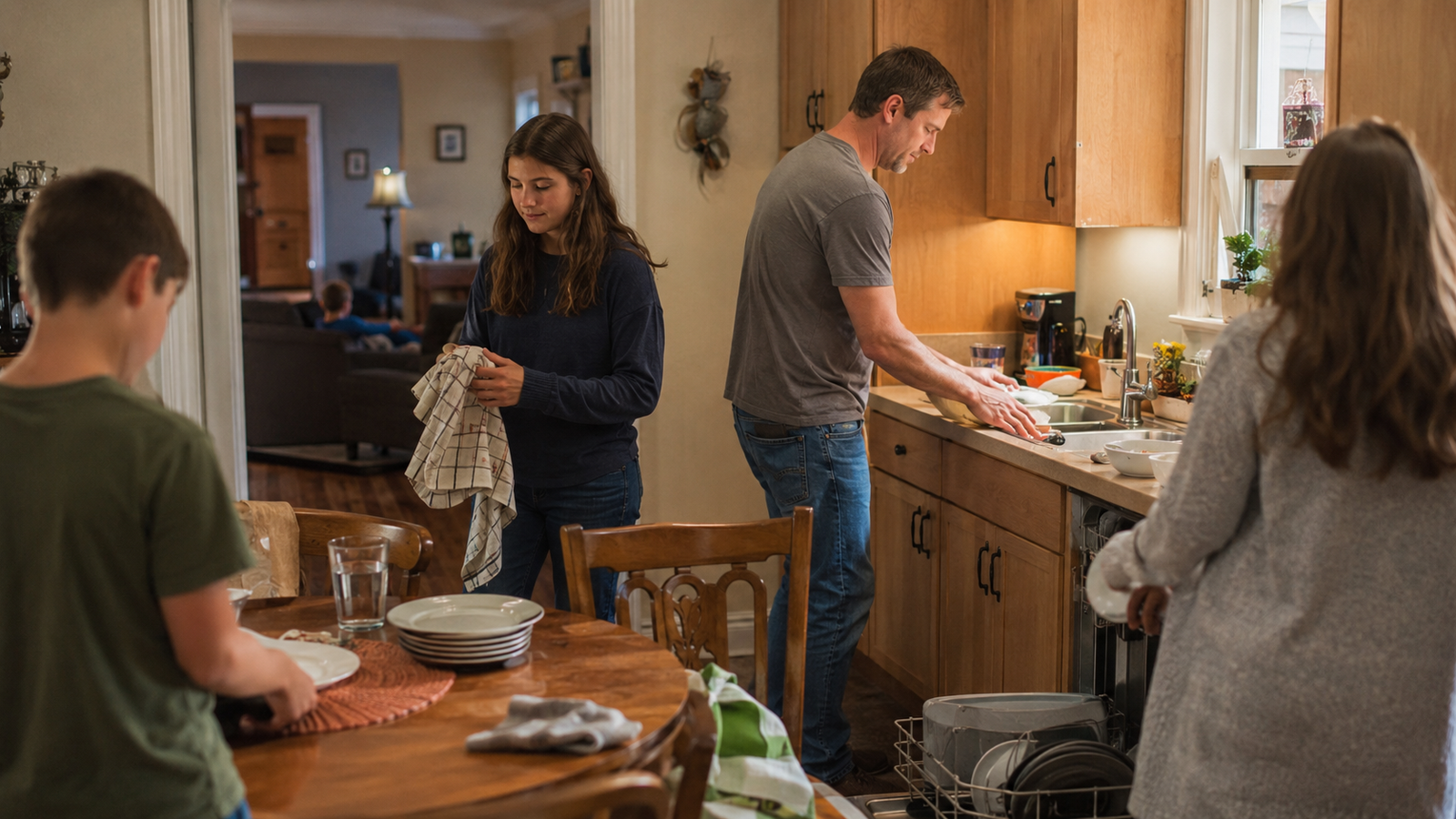
It means making decisions with the people closest to you in mind. It means showing up for ordinary life, not only emergencies and celebrations. It means contributing to the work of the household, knowing what your family is carrying, and refusing to use exhaustion, ambition, pride, or discomfort as permanent excuses for checking out.
It also means accepting that love creates obligations. Not unlimited obligations, and not blind obedience, but real responsibilities that should affect how a man spends his time, earns money, handles conflict, protects trust, and responds when someone close to him is struggling.
| Family first is | Family first is not |
|---|---|
| Primary stewardship of the people closest to you | Treating the family as more important than every other human being |
| Presence, attention, and shared responsibility | Paying the bills and considering the job complete |
| Leadership through steadiness and example | Control, entitlement, or unquestioned authority |
| Protecting the household from real harm | Shielding relatives from every consequence |
| Making sacrifices with honesty and purpose | Erasing yourself until resentment takes over |
| Remaining loyal without abandoning judgment | Excusing destructive behavior because it comes from family |
Presence Comes Before Performance
A man can live in the house, attend the events, earn the income, and still remain distant from the life happening around him.
Physical proximity is not enough. A family experiences presence when a man pays attention, notices what is changing, participates without waiting to be managed, and remains available for conversations that do not have a quick solution.
This is harder than it sounds. Work, phones, fatigue, private worries, and the desire for a little peace can consume the attention a man intended to give at home. A difficult week can become a permanent pattern before anyone names it.
Being present at home means more than sitting in the room. It means allowing the people in front of you to interrupt your internal momentum long enough to be heard, understood, and taken seriously.
Presence is usually ordinary
It looks like putting the phone down, knowing which responsibilities keep falling on the same person, listening without immediately correcting, helping without expecting applause, and staying patient when everyone in the house is tired.
These moments rarely feel important while they are happening. Over time, they become the evidence that a man was truly part of his family’s life.
Family first is a pattern of presence
Providing matters, but a family also lives with a man’s attention, mood, honesty, reliability, and willingness to share the ordinary work of home.
Providing Matters, but It Is Not the Whole Job
Financial provision is real responsibility. Housing, food, transportation, insurance, repairs, education, and emergencies do not pay for themselves. A man should not dismiss earning and planning as old-fashioned obligations that no longer matter.
But work can become a nearly perfect excuse for absence because the sacrifice looks respectable.
A man may spend every available hour earning, solving, building, or advancing, then point to the income as proof that the family received what it needed. The family may be grateful for the money and still grieve the man’s absence. Those two truths can exist together.
Providing without disappearing into work requires deciding what the work is for. Ambition, overtime, travel, promotion, or business growth should support a family life the man is still part of, not steadily replace it.
Some seasons will be unbalanced
There are times when work must demand more. A financial crisis, deployment, new business, major contract, illness, harvest, shutdown, or emergency may require unusual sacrifice.
Family first does not mean pretending every week can be perfectly balanced. It means the sacrifice has a reason, the people affected understand it, the cost is acknowledged, and the arrangement is not allowed to continue forever merely because everyone learned to survive it.
A paycheck can support a family. It cannot listen, apologize, notice, teach, comfort, or share the ordinary work of living together.
A Man Brings His Family History Home With Him
No man enters family life untouched by the family that formed him.
He brings ideas about anger, affection, authority, money, apology, conflict, weakness, work, and loyalty. Some of those lessons are worth preserving. Others were adaptations to a household that could not give him what he needed.
A man may have learned that silence prevents conflict, that control creates safety, that ridicule produces discipline, or that men prove love through work rather than words. Those habits may feel natural because they were practiced around him long before he understood them.
Understanding where a pattern came from matters. It can help a man recognize why he reacts so strongly when he feels ignored, embarrassed, afraid, or unable to solve a problem. But understanding becomes an excuse when it is used to avoid change.
Breaking family patterns without blaming the past forever means telling the truth about what shaped you while accepting that the people living with you now should not have to keep paying for it.

Family First Does Not Mean Protecting Every Family Choice
Loyalty matters. Families should not discard one another at the first mistake, inconvenience, or season of trouble.
But loyalty becomes destructive when it requires lying, financing repeated harm, hiding dangerous behavior, absorbing abuse, or protecting a relative from every consequence of their own decisions.
Enabling often begins with compassion. Someone is in trouble. The family wants the immediate crisis to stop. Money is provided, an excuse is made, a consequence is prevented, or everyone else is asked to tolerate one more incident.
For the moment, the pressure drops. Then the pattern returns.
Family loyalty without enabling bad behavior asks whether help supports responsibility or merely transfers the cost to everyone else. Real loyalty cares about the person’s long-term good, protects the rest of the household, and refuses to call harmful protection love.
Family first does not require keeping violence, threats, abuse, theft, or dangerous behavior private. Protection of vulnerable people comes before preserving appearances or avoiding family conflict.
Leadership at Home Is Stewardship, Not Rule
The language of family leadership has been abused often enough that some men avoid it entirely. That is understandable. Too many people have used “leadership” to justify control, entitlement, emotional distance, or the belief that one adult should obey another.
That is not leadership. It is authority claimed without the discipline required to deserve trust.
Leadership at home means helping the household remain steady when circumstances become difficult. It means accepting responsibility without demanding superiority. It means initiating hard conversations, admitting mistakes, planning ahead, protecting people from harm, and carrying a fair share of work without waiting to be praised.
Sometimes leadership means making a difficult decision. Often it means listening long enough to realize the decision is not yours alone.
| Steady family leadership | Control disguised as leadership |
|---|---|
| Accepts responsibility | Claims privilege |
| Invites honest disagreement | Treats disagreement as disrespect |
| Admits mistakes and repairs harm | Protects authority by refusing apology |
| Makes decisions with the household | Announces decisions to the household |
| Protects people from real harm | Controls people to reduce personal anxiety |
| Models the standard expected of others | Creates standards that apply only downward |
A household-level check
Look at the calendar, the division of labor, unresolved tension, and who absorbs the consequences of your habits. Priorities become visible in repeated arrangements.
Family First Includes Boundaries
Putting family first does not require a man to surrender every private need, friendship, interest, or hour of rest.
A man who never rests, never maintains his health, never protects his marriage, and says yes to every family request will eventually become resentful, unreliable, or another person the household must carry.
Healthy family commitment includes limits. Adults need space, sleep, exercise, friendships, useful work, reflection, and time to recover. Children need attention, but they also need growing independence. Older relatives may deserve care without receiving unlimited control over the household.
The question is not whether a man has boundaries. The question is whether those boundaries help him return more available and responsible, or whether they have become a respectable wall behind which he disappears.
What Family First Looks Like in Practice
The Tenet is lived through repeated behavior rather than one grand gesture.
- Be where you are. Put distractions down often enough that the people beside you experience your attention.
- Share ownership. Notice recurring responsibilities instead of waiting for someone else to assign them.
- Make work serve a defined purpose. Earn, build, and advance without allowing ambition to consume the life it was meant to support.
- Handle conflict without damaging the relationship. Stay honest without humiliation, contempt, intimidation, or withdrawal.
- Apologize plainly. Name what you did, acknowledge the effect, and let changed behavior finish the sentence.
- Protect without controlling. Take danger seriously while respecting the judgment and dignity of other adults.
- Help without enabling. Support responsible action rather than repeatedly erasing consequences.
- Build repeatable traditions. Meals, calls, visits, repairs, celebrations, or simple routines become part of the family’s memory because they continue.
The Family Does Not Need a Flawless Man
A man will become distracted. He will work too much during some seasons, lose patience, miss what someone needed, repeat something he thought he had outgrown, or hold a boundary poorly.
Family first does not demand perfection. It demands accountability and return.
The dependable man is not the one who never gets it wrong. He is the one who can be corrected without collapsing into self-pity or exploding into defense. He notices the distance, names his part, repairs what he can, and changes the pattern long enough for the family to trust the change.
That kind of humility matters more than maintaining the image of a strong father, husband, son, brother, or provider who never needs correction.
Family First Is the Pattern They Live With
Years from now, the people closest to a man may not remember every bill he paid, every late night he worked, every argument he won, or every principle he claimed.
They will remember whether he was reachable. Whether he listened. Whether he made the house steadier or more anxious. Whether his loyalty protected them or trapped them. Whether he could admit when he was wrong. Whether his presence remained after the crisis ended and the ordinary work resumed.
Family first is not a slogan placed above the door. It is the accumulated effect of a man’s choices inside it.
Show up. Carry your share. Tell the truth. Protect without controlling. Provide without disappearing. Stay long enough for love to become a dependable pattern rather than a claim.